The inspection process
What Happens During a Commercial Roof Inspection
A commercial roof inspection is a single visit in which our team gains roof access, reviews every drain, penetration and seam, runs our robotic scan below the membrane, and documents each finding with geo-tagged photos.
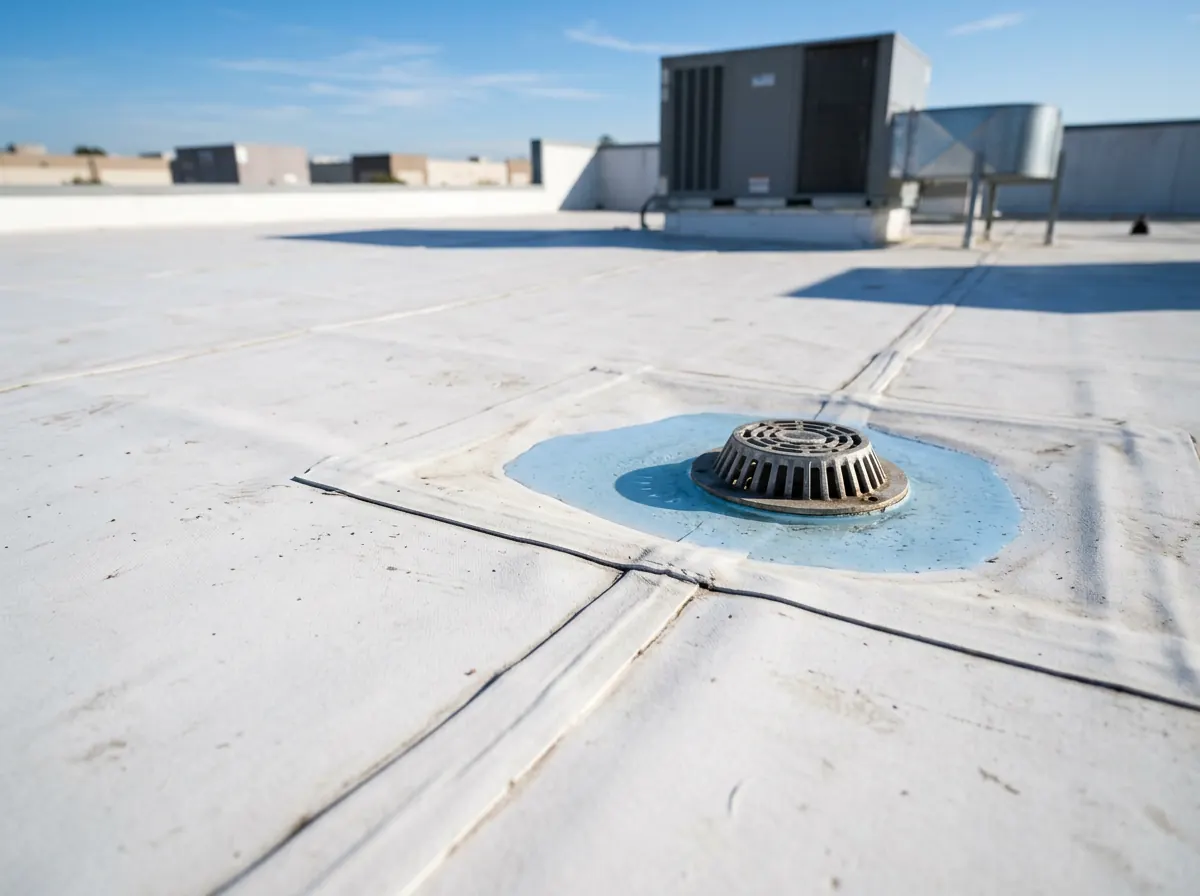
What happens during a commercial roof inspection?
During a commercial roof inspection, our team confirms access, identifies the roof system, walks and photographs the surface, scans the roof assembly for moisture and deficiencies, and leaves with the data for a PE-stamped report delivered within 48 hours.
The commercial roof inspection process follows the same order on every building, so results can be compared from one year to the next.
Confirm access and safety
We meet your contact, reach the roof by the building hatch, fixed ladder or a lift, and set up fall protection where the roof edge requires it.
Identify the roof system
The inspector records the membrane, the attachment method and any visible layers, then notes the drainage layout and rooftop equipment.
Review the critical points
Drains, scuppers, gutters, penetrations, HVAC curbs, flashings, parapets and seams are checked and photographed first, because most leaks start there.
Run the robotic scan
Our scan covers the roof in a systematic pattern at roughly 50,000 square feet an hour, reading moisture and deficiencies below the surface.
Geo-tag every finding
Each defect is photographed and tied to its location, so a repair crew or a future inspector can walk straight to it.
Close out on site
Before leaving, we tell your contact about anything urgent, such as an active leak path or a blocked drain, rather than waiting for the report.
Deliver the report
Within 48 hours you receive the PE-stamped report with the Moisture Map, Deficiency Map, Roof Condition Score, Remaining Service Life and roof plans.
How do you access the roof?
We access the roof through the building roof hatch or a fixed ladder whenever one exists, and bring a lift or extension ladder with tie-offs when the building has no safe interior access.
We ask for access details when we schedule, so we arrive with the right equipment. Locked hatches, alarmed doors and secured roof areas are all common, and a key or code sent in advance saves time on the day.
- Tell us where the hatch or ladder is and whether it is locked or alarmed.
- Let us know about any restricted zones, such as secured tenant equipment areas.
- Share the roof plan or prior reports if you have them. The request form accepts up to 10 files.
Does anyone need to be on site?
Someone needs to be on site only long enough to open roof access and point out any restricted areas; after that, our team works independently and checks out with your contact before leaving.
Property managers often meet us at the start and return to their day. If an urgent condition turns up, we call your contact from the roof. Nobody needs to accompany the inspector, and we do not need access to tenant spaces for a standard inspection.
Will a roof inspection disrupt the tenants?
A commercial roof inspection rarely disrupts tenants because the work stays on the roof, the scan is quiet, and no building systems need to be shut down.
We schedule around deliveries, customer hours and sensitive operations when you ask. Schools can be inspected on weekends or during breaks, and medical or office buildings before or after business hours.
- No core cuts, so there is no dust, noise or risk of a new leak.
- No need to enter tenant suites for a standard inspection.
- Rooftop equipment stays running while we work around it.
How do you identify what kind of roof you have?
We identify a commercial roof by its surface material, seam type, color and texture, how the membrane is attached, and what the edges and flashings reveal about the layers underneath.
Owners often inherit a building with no roof records. Knowing the system matters, because it decides how the roof should be repaired, whether it can be restored, and which warranty terms may apply. The table below shows the clues an inspector uses, and you can use them too.
| Roof system | What it looks like | How the seams look |
|---|---|---|
| TPO | Smooth, usually white or light gray single-ply sheet. | Heat-welded seams with a narrow, fused edge. |
| PVC | Smooth, bright single-ply sheet, often white, slightly more flexible than TPO. | Heat-welded seams, similar to TPO. |
| EPDM | Black or dark gray rubber sheet with a matte finish. | Taped or glued seams, often with a visible lap. |
| Spray polyurethane foam | Seamless, slightly textured surface, usually with a white or light coating. | No seams. The foam is one continuous layer. |
| Modified bitumen | Thick rolled sheets, often with a granule surface or a coating. | Overlapping laps sealed with heat or adhesive. |
| Built-up roofing | Layers of asphalt and felt, often surfaced with gravel. | No visible seams in the field, gravel covers the surface. |
If you are unsure, choose Unknown on the request form. Identifying the roof system is part of every inspection we perform, and the report states it plainly.
More on commercial roof inspections
What else do owners ask about the commercial roof inspection process?
How long does the visit take?
Scanning runs at roughly 50,000 square feet an hour, so a 200,000-square-foot roof takes about four hours from setup to completion.
Do you need to go inside the building?
Only to reach roof access, if the hatch is inside. We do not need to enter tenant spaces for a standard inspection.
Do you inspect in the rain?
We schedule on dry days for the scan and the surface review. After a storm we can return once the roof is safe to walk.
Do you cut test samples out of the roof?
No. Our scan is non-destructive, so there are no core cuts or test squares to patch afterward.
Will you tell us about urgent problems before the report?
Yes. Anything urgent, such as an active leak path or a blocked drain, is reported to your contact before we leave.
What should we prepare before the inspection?
Roof access details, a contact on the day, and any prior reports, warranties or roof plans you can share.
Can you inspect several buildings in one day?
Often, yes. Portfolio visits are grouped by location to reduce time on site and cost per building.
Who performs the inspection?
Our trained field team performs the inspection and scan, and a licensed Professional Engineer signs and stamps the report.
When do we get the report?
Within 48 hours of the scan.
What if we do not know what kind of roof we have?
That is common. The inspector identifies the roof system on site and records it in the report.
Book a commercial roof inspection and get the report within 48 hours.
Trusted since 1983 on over 20,000 commercial roofs. California License 435836.