Commercial roofing solutions
Commercial Roofing Services Built on What the Scan Finds
Our commercial roofing services run from a 1-day repair to a full tear-off, and every scope starts from scan data: which areas are wet, where the defects are and how many years the roof has left.
Trusted since 1983 on over 20,000 commercial roofs. License 435836.
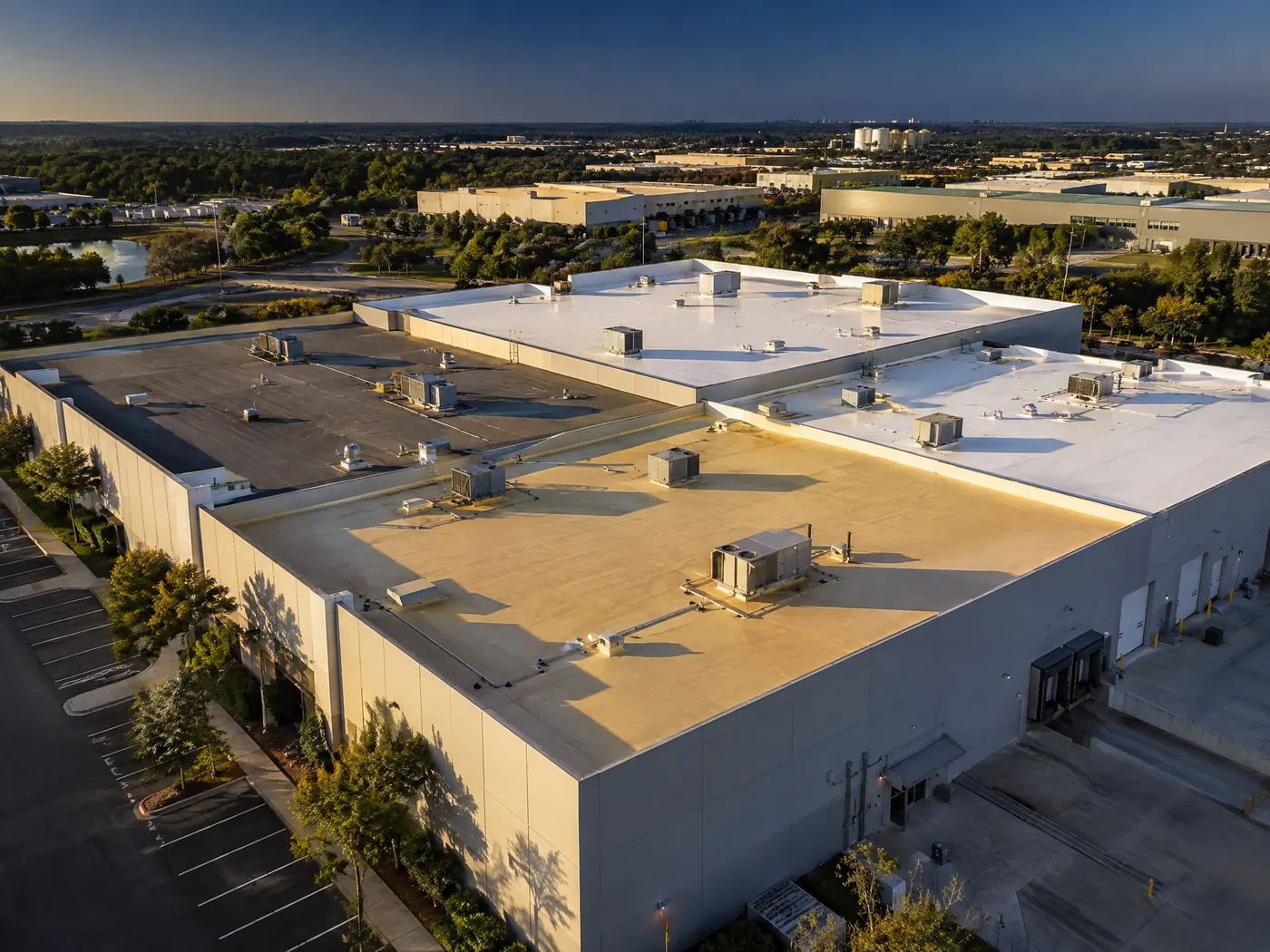
Why should commercial roofing work start with a scan?
A scan measures 100 percent of the roof, including water trapped under the membrane, so the scope covers every wet and damaged area instead of only the 1 spot someone noticed.
Most roofing proposals are written after a walk across the surface. The estimator sees blisters, open seams and ponding, and prices what is visible. The water that decides whether a roof can be saved sits in the insulation, below the membrane, where nobody standing on the roof can see it. Two proposals for the same building can differ by a factor of three because each estimator guessed differently about what is underneath.
Our scan removes the guess. It produces a Moisture Map of every wet area, a Deficiency Map of every surface defect, a Roof Condition Score from 0 to 100 and an Estimated Remaining Service Life. The repair, restoration or replacement scope is drawn from those maps, measured in square feet, and priced line by line. How the scan itself works is explained on commercial roof inspections.
How do we decide between repair, restoration and replacement?
The decision follows 2 numbers from the scan, the Roof Condition Score and the percentage of roof area holding moisture, because together they show whether the existing assembly is still worth keeping.
| Scan result | Typical path | Why |
|---|---|---|
| Score 71 to 100, little or no wet area | Repair and maintain | The assembly is sound; fix defects before they leak. |
| Score 56 to 70, small isolated wet areas | Repair, remove wet insulation | Cut out and replace only the wet sections. |
| Score 41 to 55, wet areas contained | Restore or coat | Replace wet areas, then renew the surface over dry insulation. |
| Score 0 to 40 or widespread moisture | Replace | Too much of the assembly is saturated to save. |
| Deck damage found | Replace with deck repair | A new membrane over a failing deck will not last. |
These are starting points, not rules. Building use, budget timing, warranty status and how long you plan to hold the property all move the decision, and the report sets out the options with costs so you can choose.
What does each type of roofing work buy in service life?
A repair protects the remaining life of the roof, a restoration can add roughly 10 to 20 years over a dry assembly, and a replacement starts a new service life, with commonly cited ranges shown below.
Ranges vary with system, thickness, climate and maintenance. Your report estimates the figure for your roof.
Comparing the cost of each option against the years it buys is how the cheapest proposal and the best value are told apart. A restoration at a fraction of replacement cost can be the better investment, but only if the insulation underneath is dry.
Which repair and replacement services do we provide?
We provide 5 categories of work on flat and low-slope commercial roofs: repair, replacement, restoration and coating, flat roof drainage correction and emergency leak response.
- Commercial roof repair: seams, flashings, penetrations, drains and wet insulation removal, scoped from the Deficiency Map.
- Commercial flat roof replacement: tear-off or recover, deck repair, code compliance and phased work around an operating building.
- Restoration and coating: silicone, acrylic and urethane systems over a dry, sound assembly.
- Flat roofing: drainage, ponding, tapered insulation and the details that make low-slope roofs last.
- Emergency leak response: temporary protection now and a permanent repair scoped once the area is dry.
Which commercial roof systems do we work on?
We work on 5 families of flat and low-slope roof systems: TPO, EPDM, PVC, spray polyurethane foam and modified bitumen or built-up roofing.
| System | What it is | Often chosen for |
|---|---|---|
| TPO | Heat-welded single-ply sheet | Large, sunny roofs needing reflectivity |
| EPDM | Synthetic rubber single-ply | Roofs needing flexibility in temperature swings |
| PVC | Heat-welded single-ply sheet | Restaurants and plants with grease or chemicals |
| Spray foam | Sprayed insulation with a coating | Irregular roofs and added insulation |
| Modified bitumen | Multi-ply polymer-modified bitumen sheets | Durable, redundant layers and foot traffic |
Spray foam is where Dura-Foam started in 1983, and it remains a specialty. Each system page explains how that membrane is built, how it typically fails and what the scan looks for on it.
What goes into a commercial roofing proposal from us?
Every proposal lists 6 things: the scope area in square feet, the defects being corrected, the wet insulation being removed, the materials, the schedule and the cost of each line.
Scan and report
Moisture Map, Deficiency Map, Roof Condition Score and Estimated Remaining Service Life, PE-stamped within 48 hours.
Options
Repair, restore or replace, each priced with the service life it is expected to buy.
Scope
Measured quantities taken from the maps, not estimated from the ground.
Schedule
Work phased around tenants, operations and weather.
Closeout
Photos and a record of what was done, ready for warranty or insurance files.
A proposal built from measured quantities is easier to compare, easier to approve and harder to inflate with change orders once the roof is open.
How does roofing work fit with a maintenance program?
After repair, restoration or replacement, a program keeps the roof on 2 scheduled visits a year so the new work is documented and protected from day 1.
100,000 sq ft multiplied by $0.12 to $0.15, $0.22 to $0.25 and $0.40 to $0.45 per square foot per year.
Rates and minimums are listed on maintenance programs and pricing.
Commercial roofing services
FAQs
What commercial roofing services do you offer?
Repair, replacement, restoration and coating, flat roof drainage work and emergency leak response on flat and low-slope commercial roofs.
Do you need to scan before quoting roofing work?
We recommend it. A scan shows wet insulation that a walk-on inspection cannot, which changes the scope and the price.
What makes you a commercial roofing expert?
Over 20,000 commercial roofs since 1983, a PE-stamped report on every scan and scopes measured from data.
What kinds of buildings do you work on?
Commercial buildings with flat and low-slope roofs only: warehouses, retail, schools, plants, offices and public buildings.
Can you repair a roof another contractor installed?
Yes. We repair, restore and replace TPO, EPDM, PVC, spray foam, modified bitumen and built-up roofs regardless of installer.
How do I know if my roof can be restored instead of replaced?
The Moisture Map shows how much insulation is wet. Restoration only makes sense over a mostly dry assembly.
Do you handle emergency leaks?
Yes. Manage program members receive 24-hour leak response.
Can work happen while the building is open?
Yes. Work is phased and scheduled around tenants and operations.
Are your proposals itemized?
Yes. Each line lists the quantity, unit and cost drawn from the scan maps.
What license do you hold?
California contractor license 435836.
Do professional commercial roofing services include documentation?
Ours do. Every job closes with photos and a written record for your roof file.
How do I start?
Request a roof scan or call (310) 647-7192.
Scope your roof from data, not a guess.
Trusted since 1983 on over 20,000 commercial roofs. California License 435836.