Commercial flat roofing
Flat Roofing Company Focused on Drainage and Hidden Moisture
As a flat roofing company, we treat drainage as the first design problem, because a low-slope roof sheds water at as little as 1/4 inch per foot and any low spot holds it.
Flat roofs fail from standing water, open details and moisture trapped below the surface.
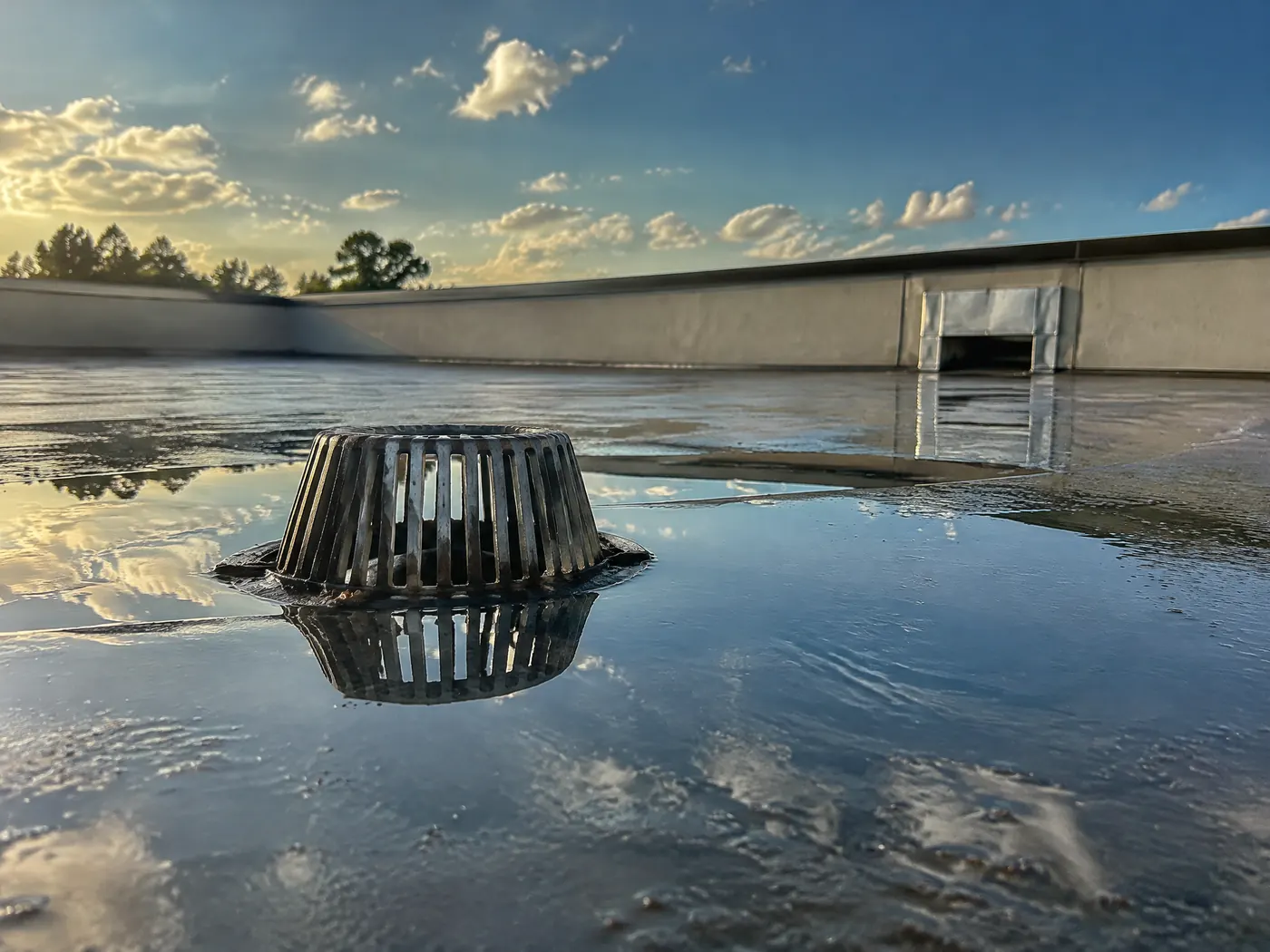
Why do flat roofs fail differently from pitched roofs?
A flat roof relies on 1 continuous waterproof membrane rather than overlapping units that shed water by gravity, so a single open seam or low spot lets water sit and enter.
| Factor | Low-slope commercial roof | Steep-slope roof |
|---|---|---|
| How water is shed | Slowly, toward drains and scuppers | Quickly by gravity |
| Waterproofing | One continuous membrane | Overlapping units shed water |
| Standing water | Common at low spots | Rare |
| Rooftop equipment | HVAC, curbs, piping, foot traffic | Usually little or none |
| Where leaks start | Seams, flashings, drains, penetrations | Valleys, flashings |
| Hidden moisture | Spreads through insulation unseen | Usually shows quickly inside |
How much slope does a flat commercial roof need?
Model building codes generally call for at least 1/4 inch of slope per foot on new low-slope membrane roofs, achieved with a sloped structure or tapered insulation.
Simple arithmetic: slope multiplied by 100 feet. Older roofs and some recovers may have less slope than current code calls for.
What causes ponding water on a flat roof?
Ponding has 4 usual causes: clogged drains, deck deflection, crushed or wet insulation and too little slope, and a common industry definition is water still standing 48 hours after rain.
- Clogged drains and scuppers from leaves, debris and loose gravel.
- Deck deflection between supports, especially on long spans.
- Insulation crushed by foot traffic or soaked with water.
- Too little slope from original construction or a later recover.
Ponding speeds membrane aging, adds weight and turns any small opening into a constant leak. Tapered insulation crickets and saddles redirect water toward drains during repair or replacement.
Why is hidden moisture the main risk on a flat roof?
On a flat roof, 1 small opening can wet insulation across a wide area before any water shows inside, because the water spreads horizontally through the assembly.
By the time a ceiling stain appears, the wet area can be many times larger than the stain. Our scan reads through the membrane to map that water, so a repair or reroof removes all of it. The scan method is covered on commercial roof inspections.
What should a flat roof contractor check on every visit?
A flat roof contractor should check 5 areas on every visit: drains, seams, flashings, penetrations and the paths workers use to reach equipment.
Drains and scuppers
Clear, strainers in place, clamping rings tight.
Seams
Probed for openings, especially near drains and at corners.
Flashings
Walls, curbs and edges intact and terminated.
Penetrations
Boots, pitch pans and pipe supports sealed.
Traffic paths
Punctures and scuffs along routes to HVAC units.
The full item list is in our preventative maintenance checklist.
FAQs
What does a flat roofing company do?
Installs, repairs, restores and maintains low-slope roof systems on commercial buildings.
Is a flat roof really flat?
No. Commercial flat roofs are low-slope, typically built to at least 1/4 inch per foot.
How long should ponding water last?
A common industry benchmark is that water should be gone within 48 hours after rain.
Can ponding be fixed without replacing the roof?
Often. Drain work, tapered insulation crickets or local rebuilding can correct it.
Which membranes work best on flat roofs?
TPO, PVC, EPDM, spray foam and modified bitumen are all designed for low-slope roofs.
Why does my flat roof leak far from the stain?
Water travels through the insulation and along the deck before it drips.
Do you work as a commercial flat roofing company only?
Yes. We work only on flat and low-slope commercial roofs.
How often should a flat roof be inspected?
Twice a year, spring and fall, and after major storms.
Do flat roofs need walkway pads?
Pads along routes to rooftop equipment reduce traffic damage.
What do flat roofing specialists look for first?
Drainage. Standing water drives most other failures.
How do I get started?
Request a roof scan or call (310) 647-7192.
Find out where the water on your flat roof is going.
Trusted since 1983 on over 20,000 commercial roofs. California License 435836.