Commercial roof coating
Commercial Roofing Restoration and Coating Over a Dry Roof
Commercial roofing restoration renews the surface of a sound roof with a fluid-applied coating, and it only works when the scan confirms the insulation underneath is dry.
Coating over wet insulation seals the water in and spends the budget twice.
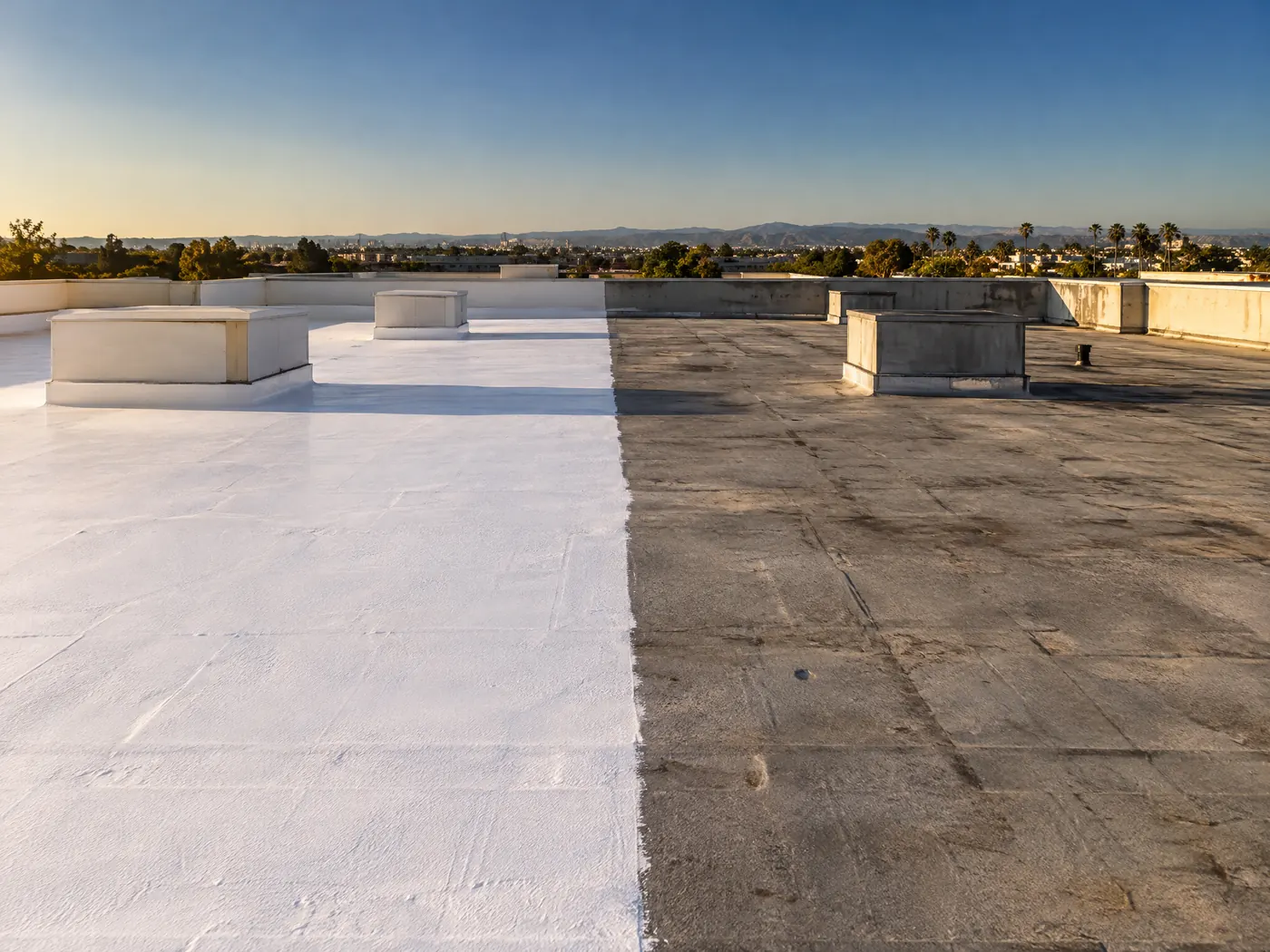
When is a roof coating the right choice?
A coating is the right choice when the roof scores roughly 41 to 70, the wet area is small enough to remove first, and the membrane is still attached to a sound deck.
- The Moisture Map shows only small, isolated wet areas that can be cut out and replaced.
- The membrane is weathered but still adhered and continuous.
- Seams and flashings can be reinforced before coating.
- Drainage is adequate or can be corrected for the chosen coating.
- The owner wants to defer the capital cost of replacement.
Why is coating over wet insulation money wasted?
Coating over wet insulation seals water inside the assembly, where it keeps damaging the deck and the insulation while the 1 new surface looks perfect from above.
Wet insulation loses most of its thermal value and stays wet for years once the roof above it is sealed. The coating may also blister or lose adhesion as trapped moisture tries to escape. Most coating manufacturers require the substrate to be dry before they will warrant the system, which makes a moisture survey a precondition, not an extra.
Our scan maps every wet area without cutting cores, so the restoration scope removes the wet insulation first and coats only over dry roof. The scan is described on commercial roof inspections.
How do silicone, acrylic and urethane coatings compare?
The 3 main coating families trade off ponding resistance, durability under foot traffic and how easily they can be recoated later.
| Property | Silicone | Acrylic | Urethane |
|---|---|---|---|
| Ponding water | Tolerates ponding well | Weak under ponding | Moderate to good |
| UV resistance | Excellent | Very good | Good, aromatic types need a top coat |
| Foot traffic and impact | Softer, collects dirt | Moderate | Toughest of the 3 |
| Recoating later | Usually only with more silicone | Easy | Good with compatible coats |
| Application weather | Cures in cooler, damper conditions | Needs warm, dry weather | Moisture-sensitive during cure |
| Common use | Flat roofs with ponding | Sloped, well-drained roofs | High-traffic and spray foam roofs |
How many years does a restoration add?
A restoration over a dry assembly commonly adds 10 to 20 years, depending largely on how many mils of coating are applied and how the roof is maintained afterward.
Manufacturers commonly tie warranty length to dry film thickness. Exact terms depend on the product and are confirmed in the proposal.
What are the warranty implications of coating a roof?
Coating a roof can affect 2 warranties: the original membrane warranty, which may be voided by an unapproved coating, and the new coating warranty, which usually requires a dry, prepared substrate.
- Check the existing membrane warranty before coating; some manufacturers restrict third-party coatings.
- Coating warranties typically require documented moisture testing and surface preparation.
- Periodic inspections and maintenance are often a warranty condition.
- Our report and repair records support both the inspection and the dry-substrate requirement.
How is a commercial roof restoration done?
A restoration runs in 6 steps, and the first is always removing wet insulation found on the Moisture Map.
Remove wet areas
Cut out wet insulation and replace it with dry material.
Clean
Low-pressure cleaning removes dirt, chalking and biological growth.
Repair
Seams, flashings, penetrations and blisters are reinforced.
Prime
A primer is applied where the coating and substrate require it.
Coat
Base and top coats are applied to the specified thickness.
Verify and record
Thickness is checked and the work is photographed for the file.
When too much of the roof is wet for restoration, the better path is replacement.
More commercial roofing services
FAQs
What is commercial roofing restoration?
Renewing a sound flat roof with repairs and a fluid-applied coating instead of replacing it.
Roof restoration vs replacement for a commercial building: which is better?
Restoration costs less when the insulation is mostly dry. Widespread moisture means replacement.
Can any flat roof be coated?
Most single-ply, modified bitumen, built-up and spray foam roofs can be, if the substrate is dry and sound.
Does a flat roof coating stop leaks?
A coating renews the surface, but leaks are stopped by repairing their cause first.
Which coating is best for ponding water?
Silicone generally tolerates ponding best, though correcting drainage is still preferred.
Do coatings improve energy performance?
Reflective white coatings can lower roof surface temperature in sunny climates.
How long does a coating last?
Commonly 10 to 20 years, depending on thickness and maintenance, and it can often be recoated.
Will coating void my membrane warranty?
It can. Check the warranty terms before any coating is applied.
Do you test for moisture before coating?
Yes. The scan maps wet areas, and they are removed before coating.
Can a coating be part of a program?
Yes. Coated roofs are inspected and maintained on Monitor, Protect or Manage.
How do I get a restoration quote?
Request a roof scan or call (310) 647-7192.
Confirm the roof is dry before you coat it.
Trusted since 1983 on over 20,000 commercial roofs. California License 435836.