Roof capital expenditure planning
Roof Capital Planning: From Condition Score to Funded Schedule
Roof capital planning converts each roof's Roof Condition Score and Estimated Remaining Service Life into a year-by-year replacement budget, so the money is set aside before the roof fails.
The worked 5-year example below shows the method from scan data to budget line.
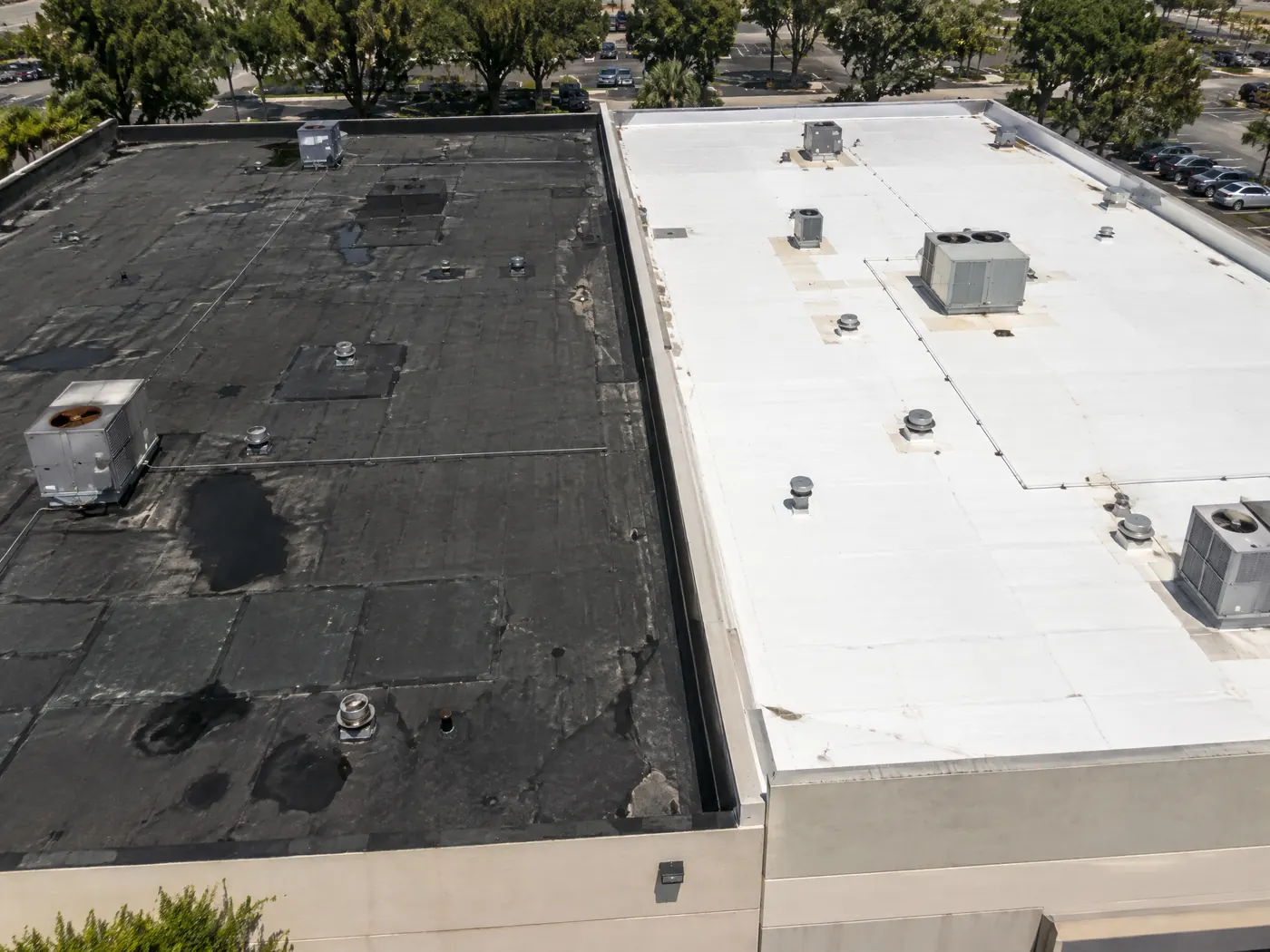
How does a service life number become a budget line?
A service life of 3 years means the replacement cost belongs in the capital budget for year 3, with the amount set by roof area multiplied by a current cost per square foot.
- Estimated Remaining Service Life sets the year.
- Roof area multiplied by a current replacement rate sets the amount.
- Repairs in the 1-3 Year Recommendations go into the operating budget before then.
- Each new scan moves the year earlier or later as the roof changes.
How the service life figure itself is estimated is covered on remaining service life.
What does a worked 5-year roof capital plan look like?
A 5-year plan for 3 example buildings schedules 1 replacement in year 1, 1 restoration in year 3 and routine maintenance on the third roof, spreading $1.13 million across 5 budget years.
| Building | Area | Score | Years left | Action | Budget year | Amount |
|---|---|---|---|---|---|---|
| A: warehouse | 120,000 sq ft | 38 | 1 | Replace | Year 1 | $960,000 |
| B: office | 40,000 sq ft | 58 | 4 | Restore and coat | Year 3 | $120,000 |
| B: office | 40,000 sq ft | 58 | 4 | Immediate Repairs | Year 1 | $9,000 |
| C: retail | 60,000 sq ft | 82 | 12 | Maintain | Years 1 to 5 | $8,000 a year in repairs |
How is the worked example spread across 5 budget years?
Year 1 carries $977,000 because Building A has 1 year left, year 3 carries $128,000 for the Building B restoration, and years 2, 4 and 5 hold $8,000 each.
Example data. Year 1: $960,000 + $9,000 + $8,000. Year 3: $120,000 + $8,000. Program fees are budgeted separately.
How do reserve studies use roof scan data?
A reserve study needs 2 figures for each roof, a remaining life and a replacement cost, and our scan supplies both from measured data instead of an age-based assumption.
| Reserve study input | Age-based assumption | From our scan |
|---|---|---|
| Remaining life | Typical life minus roof age | Estimated Remaining Service Life |
| Condition | Visual note, if any | Roof Condition Score, 0 to 100 |
| Hidden moisture | Not considered | Moisture Map, percent of area wet |
| Near-term repairs | Rarely itemized | Immediate Repairs and 1-3 Year Recommendations |
| Update cycle | Every few years | Every scan |
How does a sinking fund pay for a roof replacement?
A sinking fund divides the replacement cost by the years remaining, so a $480,000 roof with 6 years left needs $80,000 set aside each year.
Example data, before interest or inflation. More years of notice means a smaller annual contribution.
Extending service life with maintenance lowers the yearly contribution, which is the case for a program covered on maintenance programs and pricing.
When should you budget for a new commercial roof?
Budget for a new commercial roof once the Estimated Remaining Service Life drops to 5 years or the score falls below 56, because that leaves at least 1 full budget cycle to fund it.
- 86 to 100, Excellent: maintain, no capital line needed yet.
- 71 to 85, Good: prevent, watch the score each year.
- 56 to 70, Fair: repair, and price a restoration option.
- 41 to 55, Poor: restore within 1 to 3 years or schedule replacement.
- 0 to 40, Critical: replace, and fund in the next budget.
More on roof asset management
FAQs
What is roof capital planning?
Scheduling and funding roof replacements and restorations from measured condition and remaining life.
What is roof capital expenditure planning?
The same process, framed as capital expenditure: which roofs need capital, in which year and for how much.
How do I build a roof replacement budget?
Multiply each roof area by a current replacement rate, then place it in the year its service life runs out.
How accurate is the service life estimate?
The estimate comes from measured moisture, condition and age, and is refreshed at each scan so the plan stays current.
Can restoration replace a planned replacement?
Sometimes. A roof with a small wet area can often be restored, which moves the replacement year further out.
Do you provide replacement prices?
Each report prices Immediate Repairs and 1-3 Year Recommendations and includes a Capital Planning Recommendation for the replacement year.
Does scan data work for HOA or institutional reserve studies?
Yes. The roof figures can be handed to the reserve specialist preparing the study.
How often should the plan be updated?
At every scan, usually once or twice a year on a program.
What if two roofs reach the end of life in the same year?
Compare scores, moisture and what sits below each roof, then stagger by restoring the stronger one.
Do the example figures on this page apply to my roof?
No. They illustrate the method. Your own report prices your roofs.
Which roofs can be planned this way?
Flat and low-slope commercial roofs of any membrane type.
How do I start?
Request a roof scan or call (310) 647-7192.
Fund your next roof before it fails.
Trusted since 1983 on over 20,000 commercial roofs. California License 435836.