PVC membrane roof
PVC Roofing Contractor for Grease, Chemicals and Process Exhaust
PVC is a heat-welded single-ply membrane chosen for 1 main reason: it resists the grease, animal fats and many chemicals that soften and swell other roof membranes.
We repair, restore and replace PVC roofs on restaurants, food processing plants and manufacturing buildings.
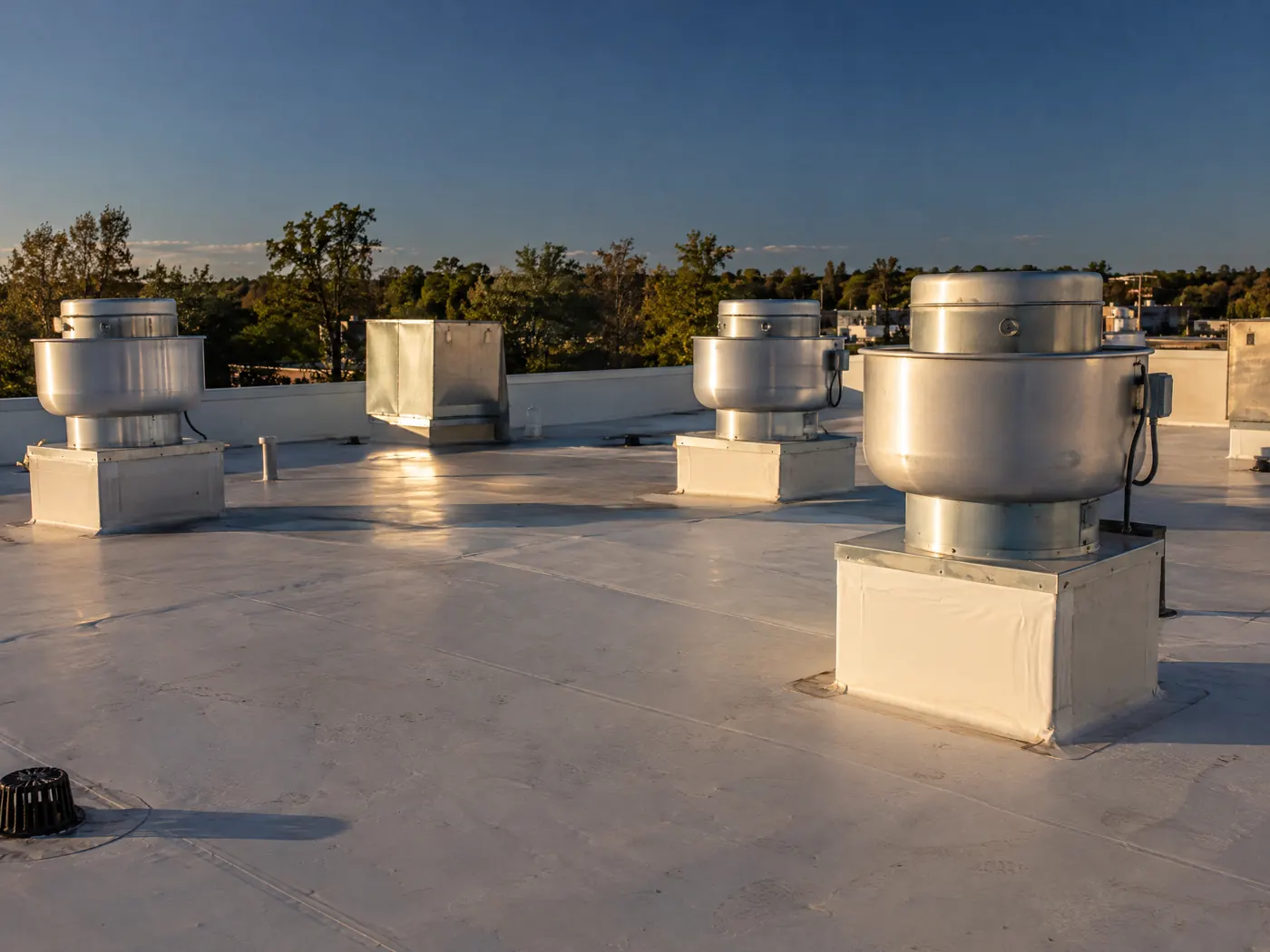
Which rooftop exposures make PVC the better choice?
PVC is usually specified where at least 1 rooftop exposure involves grease, animal fat, oils or process chemicals, because those contaminants attack many other membranes.
| Building type | Rooftop exposure | Effect on non-resistant membranes | PVC suitability |
|---|---|---|---|
| Restaurant | Kitchen grease from exhaust fans | Softening and swelling around fans | Strong, grease-resistant grades |
| Food processing | Animal fats and cooking oils | Membrane breakdown near vents | Strong |
| Manufacturing | Process exhaust and chemical fallout | Surface degradation | Good, confirm with the manufacturer |
| Airport or fuel area | Jet fuel or hydrocarbons | Attack on bitumen and rubber | Check product chemical charts |
| Office or warehouse | Little contamination | Minimal | Works, though not required |
Why do restaurants and manufacturers choose PVC?
Restaurants and plants choose PVC because 1 grease or chemical discharge point can destroy the membrane around it on other systems, and PVC is made to resist that attack.
- Grease from kitchen exhaust collects around fans and runs toward drains.
- Rooftop grease containment and PVC together limit damage around exhaust points.
- Welded seams create a continuous sheet with no adhesive for contaminants to attack.
- Many PVC products are also highly reflective for cool roof requirements.
What is plasticizer migration in a PVC roof?
PVC contains plasticizers that keep it flexible, and over 15 to 20 years or more some can migrate out, leaving the sheet stiffer and more prone to cracking.
Migration speeds up where PVC touches incompatible materials, such as bitumen-based roofing or some polystyrene insulation, which is why a separator sheet is used in those conditions. A brittle PVC sheet becomes hard to weld for repairs, and cracking often shows first at folds, corners and flashings.
Relative order, not a measured rate. Each roof is assessed on its own condition.
How is a PVC roof repaired?
A PVC repair takes 4 steps, and the first is cleaning, because grease left on the sheet stops a new weld from bonding.
Degrease and clean
Contaminants are removed so the weld can bond.
Test weld
A sample weld checks whether the aged sheet still welds reliably.
Patch or replace
Welded patches on sound sheet; replacement where the sheet is brittle.
Map moisture
Wet insulation below is found and replaced.
Our scan maps water under the PVC sheet without cuts; see commercial roof inspections.
How long does a PVC roof typically last?
PVC is commonly cited at 20 to 30 years, with grease exposure, plasticizer loss, thickness and maintenance deciding where a given roof falls.
Regular cleaning around exhaust fans and grease containment maintenance do more to extend PVC life on a restaurant roof than any other single task.
FAQs
What is a PVC membrane roof?
A heat-welded single-ply roof made from polyvinyl chloride, used on flat and low-slope buildings.
Do you offer PVC roof repair?
Yes: welded patches, flashing repairs and replacement of brittle sections.
Is PVC better than TPO for restaurants?
Generally yes, because PVC resists kitchen grease that can damage TPO.
What is plasticizer migration?
Gradual loss of the additives that keep PVC flexible, leaving it stiffer over time.
Can PVC go over a built-up or modified bitumen roof?
Only with a separator, because bitumen can draw plasticizers out of PVC.
Do I need grease containment on a PVC roof?
It is strongly recommended around kitchen exhaust fans.
Can old PVC be welded?
Often, after cleaning. A test weld confirms it.
Is PVC reflective?
Many white and light gray PVC products are rated for solar reflectance.
How do you find a PVC roofing contractor?
Look for experience with welded single-ply and grease-exposed roofs. Request a roof scan to start.
Can PVC be coated?
Yes, with compatible coatings, though repair or replacement is often better for brittle sheet.
How do I get a quote?
Request a roof scan or call (310) 647-7192.
Protect the roof over your kitchen or production line.
Trusted since 1983 on over 20,000 commercial roofs. California License 435836.