Commercial reroofing
Commercial Flat Roof Replacement Planned From Measured Data
Commercial flat roof replacement is the right call once the scan shows widespread wet insulation, a score below 41 or a damaged deck, and the scan then tells us whether a recover is allowed or a full tear-off is needed.
The scope, schedule and price are built from the Moisture Map, not discovered after the old roof comes off.
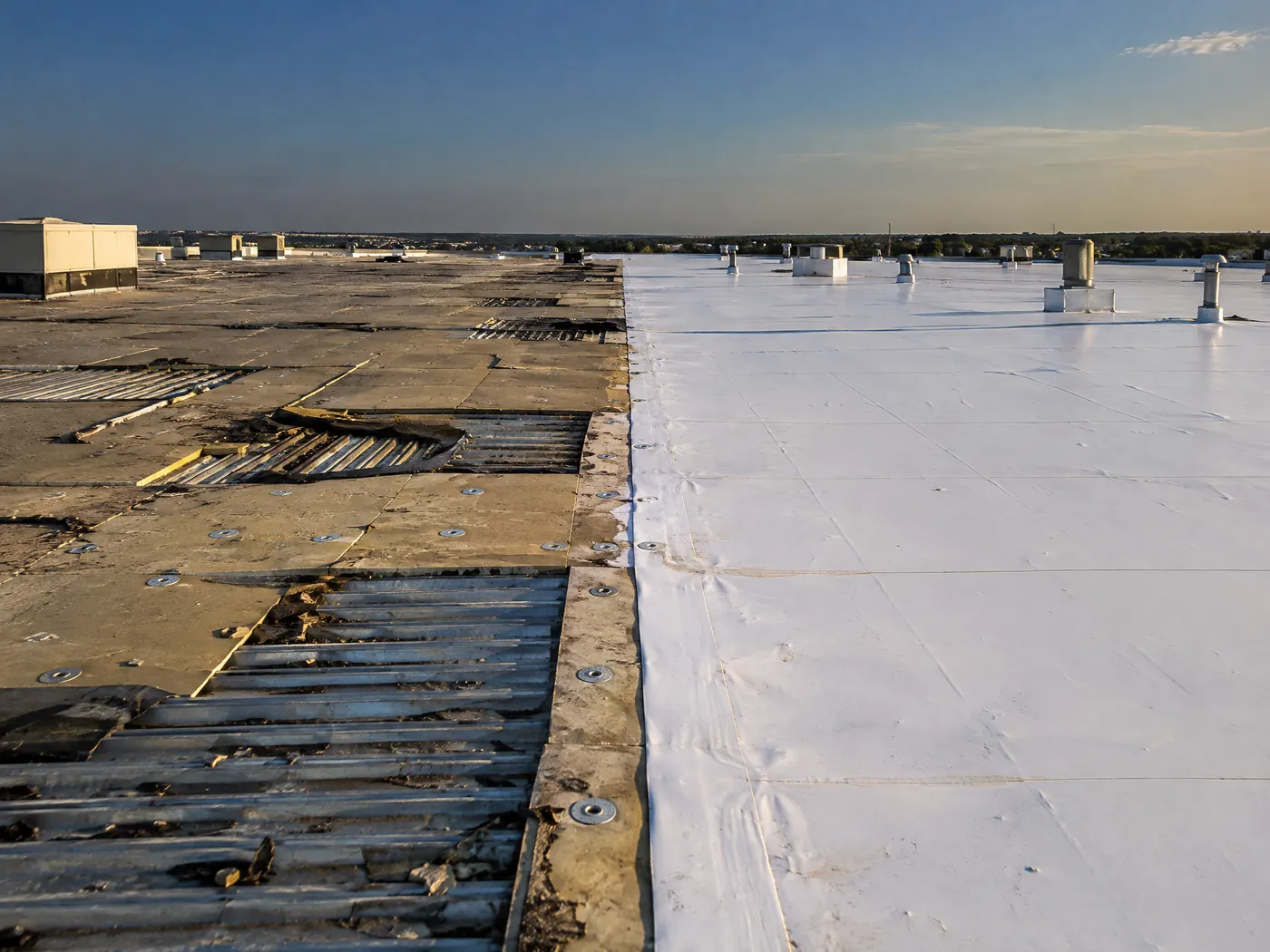
What is the difference between a tear-off and a recover?
A tear-off removes every layer down to the deck, while a recover installs 1 new roof over the existing one, and building codes allow a recover only when the existing roof is dry and there is no more than 1 roof already in place.
| Factor | Full tear-off | Recover |
|---|---|---|
| Existing layers | All removed to the deck | One existing roof stays in place |
| Wet insulation | All removed | Not permitted over a water-soaked roof |
| Deck inspection | Full, every square foot visible | Limited to scan data |
| Cost | Higher, includes removal and disposal | Lower, less labor and disposal |
| Disruption | More noise, debris and exposure | Less, roof stays closed |
| Code limit | Resets the assembly | Not allowed over 2 existing roofs |
How does the scan decide whether a recover is possible?
The scan answers the 2 questions code and good practice ask first: how much of the existing insulation is wet, and how many roofs are already on the building.
Recovering over wet insulation traps water under a brand new membrane, where it keeps rusting the deck and rotting the assembly from below. The Moisture Map shows exactly where the wet areas are. Small wet areas can be removed and replaced before a recover; widespread moisture rules it out. Without that map, the only way to know is to take cores, which samples a few spots and misses the rest. Our scan method is covered on commercial roof inspections.
What drives the cost of commercial roof replacement?
Replacement cost is driven by 6 main factors: roof area, tear-off layers, wet insulation volume, deck repairs, the new system and access to the roof.
Illustrative split only. Each project differs, and your proposal itemizes the actual quantities.
- Multiple existing layers increase tear-off time and disposal weight.
- Every square foot of wet insulation found in advance is a change order avoided.
- Rooftop units, curbs and penetrations add detail labor.
- Height, crane access and staging space affect logistics.
Why does deck condition matter in a reroof?
A new roof is only as sound as the deck under it, and corroded steel, rotted wood or spalled concrete found during tear-off is the 1 cost most likely to break a budget when it was not anticipated.
Long-term wet areas on the Moisture Map are where deck damage is most likely. We flag those zones in the proposal so an allowance for deck repair is priced up front rather than appearing as a surprise once the roof is open.
Which code requirements apply to a commercial reroof in California?
California reroofs are governed by 2 main sets of rules: the building code limits on recovering, and the Title 24 energy standards, which can require a cool roof surface and added insulation on low-slope roofs.
- Recover limits: no recover over a water-soaked roof or over 2 or more existing roofs.
- Cool roof: Title 24 sets minimum solar reflectance and emittance for many commercial low-slope reroofs.
- Insulation: replacing a large share of a roof can trigger insulation requirements.
- Permits: most reroofs need a permit and inspection from the local building department.
How is a replacement scheduled around an operating building?
Replacement is phased in sections, with each day's tear-off closed watertight before the crew leaves, so the building can stay open through 100 percent of the work.
Phase plan
The roof is divided into sections that can each be opened and closed in one day.
Tenant notice
Noisy and odorous work is timed around operations.
Daily tie-in
Each section is sealed watertight at the end of every shift.
Interior protection
Sensitive areas below are covered where needed.
Closeout
Photos, warranty registration and a new baseline scan for your records.
When replacement is still a few years away, the year and budget belong in your roof capital planning.
FAQs
How do I know my commercial roof needs replacement?
Widespread wet insulation, a score below 41 or a damaged deck usually means replacement.
Is a recover cheaper than a tear-off?
Usually, but only when the existing roof is dry and code allows it.
What is commercial reroofing?
Replacing or recovering the roof system on an existing commercial building.
Which system should replace my roof?
It depends on use, exposure and budget. TPO, PVC, EPDM, spray foam and modified bitumen are all options.
Do you handle industrial roof replacement?
Yes, including roofs over plants that cannot shut down.
Do I need a permit?
Most commercial reroofs need a permit and inspection.
Will the building need to close?
No. Work is phased and sealed watertight each day.
What happens if deck damage is found?
Likely deck damage zones are flagged in advance, and repairs are priced per unit.
Do you offer flat roof replacement services for multi-building sites?
Yes. Replacements can be sequenced across a portfolio by years remaining.
What warranty comes with a new roof?
Warranty terms depend on the manufacturer and system selected, and are set out in the proposal.
How do I get a replacement quote?
Request a roof scan or call (310) 647-7192.
Know what is under the old roof before it comes off.
Trusted since 1983 on over 20,000 commercial roofs. California License 435836.