How it works
How Our Commercial Roof Scan Works, From Request to Decision
Five steps separate a roof you are guessing about from a roof you can plan around: request, scan, analyze, report and decide.
No core cuts, no interior access and no shutdown, with a PE-stamped report in hand within 48 hours of the visit.
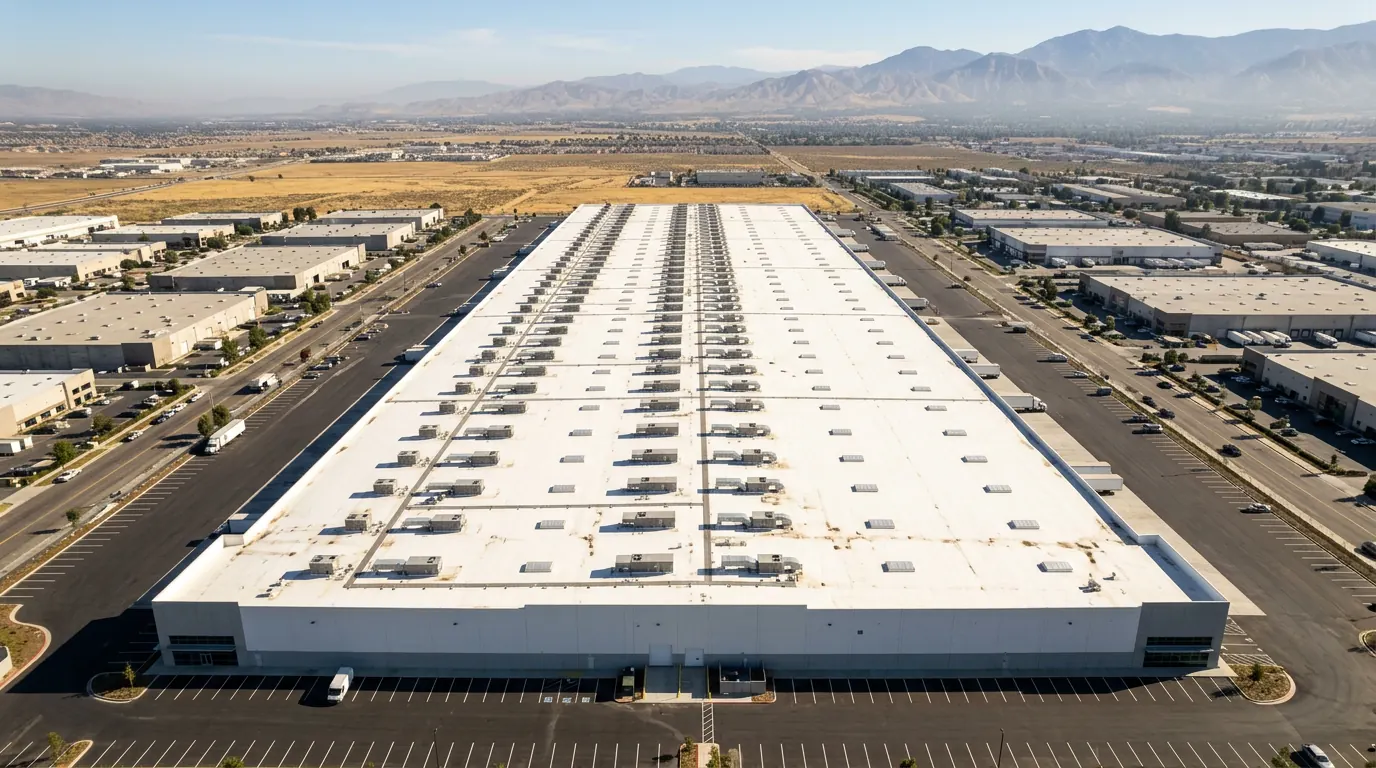
What are the 5 steps of a commercial roof scan?
The 5 steps are Request, Scan, Analyze, Report and You decide, and the whole sequence usually runs from first call to finished report in under 1 week.
Request
Send the address and approximate square footage. A quote follows within 1 business day.
Scan
A same-day visit covers about 50,000 square feet an hour with no core cuts.
Analyze
Radar, laser and thermal data from 1 pass are processed into maps and scores.
Report
A licensed Professional Engineer signs and stamps the report within 48 hours.
You decide
Repair, maintain, restore, replace or wait, with the numbers in front of you.
How fast do I get a quote after I request a roof scan?
A quote arrives within 1 business day, priced on 2 things: the total square footage of roof and the number of buildings.
The request form asks for the property address, the approximate roof area, the number of buildings and the roof type if you know it. Drawings, prior reports and photos help but are optional. A single large roof and a campus of small roofs with the same total area can price differently, because every building adds travel, setup and a separate section of the report.
Owners who want ongoing coverage rather than a single scan can compare annual maintenance programs and pricing, each of which starts with a baseline scan.
What should I prepare before scan day?
Preparation comes down to 3 things: safe roof access, a clear roof surface, and any drawings or past reports you already have.
- Access: a working hatch, fixed ladder or stair, with keys or an escort arranged for the visit.
- Surface: loose debris and stored materials moved where practical, and drains clear of standing water.
- Records: roof plans, warranty documents, prior inspection reports and leak history, if available.
- Contacts: a person on site who can answer questions about recent repairs or rooftop equipment work.
None of these are required to book. Records simply help the engineer connect what the scan finds with what has already been done to the roof, and they make warranty and repair history part of the same file.
What happens on the day of the scan?
Scan day is a single same-day visit in which our AI-assisted scan covers about 50,000 square feet an hour without cutting, coring or puncturing the roof.
The crew needs roof access through a hatch, ladder or stair and nothing inside the building. Tenants, production and patients carry on as normal. The scan travels the surface in lanes, reading the full assembly from membrane to deck, and the crew notes drains, penetrations, curbs and edges as it goes. Because nothing is opened, nothing has to be patched afterward, and no new holes are added to a roof you may be trying to keep under warranty.
Scan time only. Setup, access, rooftop equipment density and weather affect the total visit.
How is the scan data turned into a Roof Condition Score?
Radar, laser and thermal readings captured in 1 pass are combined into millions of data points, then processed into 4 core deliverables: the Moisture Map, the Deficiency Map, the Roof Condition Score and the Estimated Remaining Service Life.
- Moisture Map: every wet area in the insulation, located and sized on a plan of the roof.
- Deficiency Map: seams, flashings, drains, penetrations and edges that need attention, each geo-tagged.
- Roof Condition Score: a single number from 0 to 100 that places the roof in a condition band.
- Estimated Remaining Service Life: the years of service the roof can still deliver with the recommended work.
On our scale, 86 to 100 is Excellent, 71 to 85 is Good, 56 to 70 is Fair, 41 to 55 is Poor and 0 to 40 is Critical. The band drives the recommendation, from routine maintenance at the top of the scale to replacement planning at the bottom.
When does the report arrive and who signs it?
The report arrives within 48 hours of the scan, signed and stamped by a licensed Professional Engineer.
The engineer reviews the data, the maps and the findings before stamping, which is what gives the report weight with insurers, lenders, warranty holders, boards and auditors. Inside you will find Immediate Repairs, 1-3 Year Recommendations and a Capital Planning Recommendation, each tied to locations on the roof plan so a crew can find every item without a second visit.
Every section is explained on the sample report page.
What decisions can I make once the report is in hand?
Most owners choose among 5 paths after the report: repair now, enroll in maintenance, restore or coat, plan replacement, or document and wait.
You decide. A Good roof with a few deficiencies usually needs targeted repairs and a maintenance schedule. A Fair roof with dry insulation is often a restoration candidate, which can add years of service for far less than replacement. A Poor or Critical roof with widespread wet insulation moves into capital planning, and the report tells you how much time you have to fund it. There is no obligation to hire us for the work, and the report stands on its own with any contractor or consultant you choose.
How does our scan compare with a walk-on inspection or a drone flyover?
Our scan reads all 3 layers of the assembly, membrane, insulation and deck, while a walk-on inspection and a drone flyover mainly record what is visible on the surface.
| Factor | Our AI-assisted scan | Walk-on inspection | Drone flyover |
|---|---|---|---|
| What it reads | Membrane, insulation and deck | Visible surface only | Surface images, some thermal |
| Trapped moisture | Mapped across the whole roof | Found only if it shows on the surface | Thermal may suggest it under the right conditions |
| Core cuts | None | Sometimes, to confirm moisture | None |
| Coverage rate | About 50,000 sq ft an hour | Depends on the inspector | Fast for images |
| Output | Maps, Roof Condition Score, service life | Notes and photos | Photos and video |
| Engineer stamp | Every report | Varies | Varies |
FAQs
Do you need to go inside the building?
No. The scan needs roof access only, by hatch, ladder or stair.
Will the scan damage my roof?
No. Nothing is cut, cored or punctured.
How long does the scan take?
About 1 hour for every 50,000 square feet, plus setup and access time.
How quickly will I get a quote?
Within 1 business day of your request.
What is the quote based on?
Total roof square footage and the number of buildings.
When will I receive the report?
Within 48 hours of the scan.
Who signs the report?
A licensed Professional Engineer signs and stamps every report.
Can you scan in the rain?
The scan is scheduled for a dry roof. Standing water and active rain delay the visit.
Which roof types can you scan?
Flat and low-slope commercial roofs, including TPO, EPDM, PVC, modified bitumen, built-up and spray foam.
Do I have to hire you for repairs?
No. The report is yours to use with any contractor.
Can you scan several buildings in 1 visit?
Yes. Multi-building sites are scheduled together where access allows.
How do I start?
Request a roof scan or call (310) 647-7192.
Start with step 1 and get a quote within 1 business day.
Trusted since 1983 on over 20,000 commercial roofs. California License 435836.