SPF roofing
Spray Foam Roofing for Commercial Buildings, Our Original Specialty
Spray polyurethane foam roofing is sprayed on as a liquid that expands into 1 seamless, insulating layer, then protected by a coating that is renewed every 10 to 20 years instead of tearing the roof off.
Spray foam is where Dura-Foam began in 1983, and it remains the system we know best.
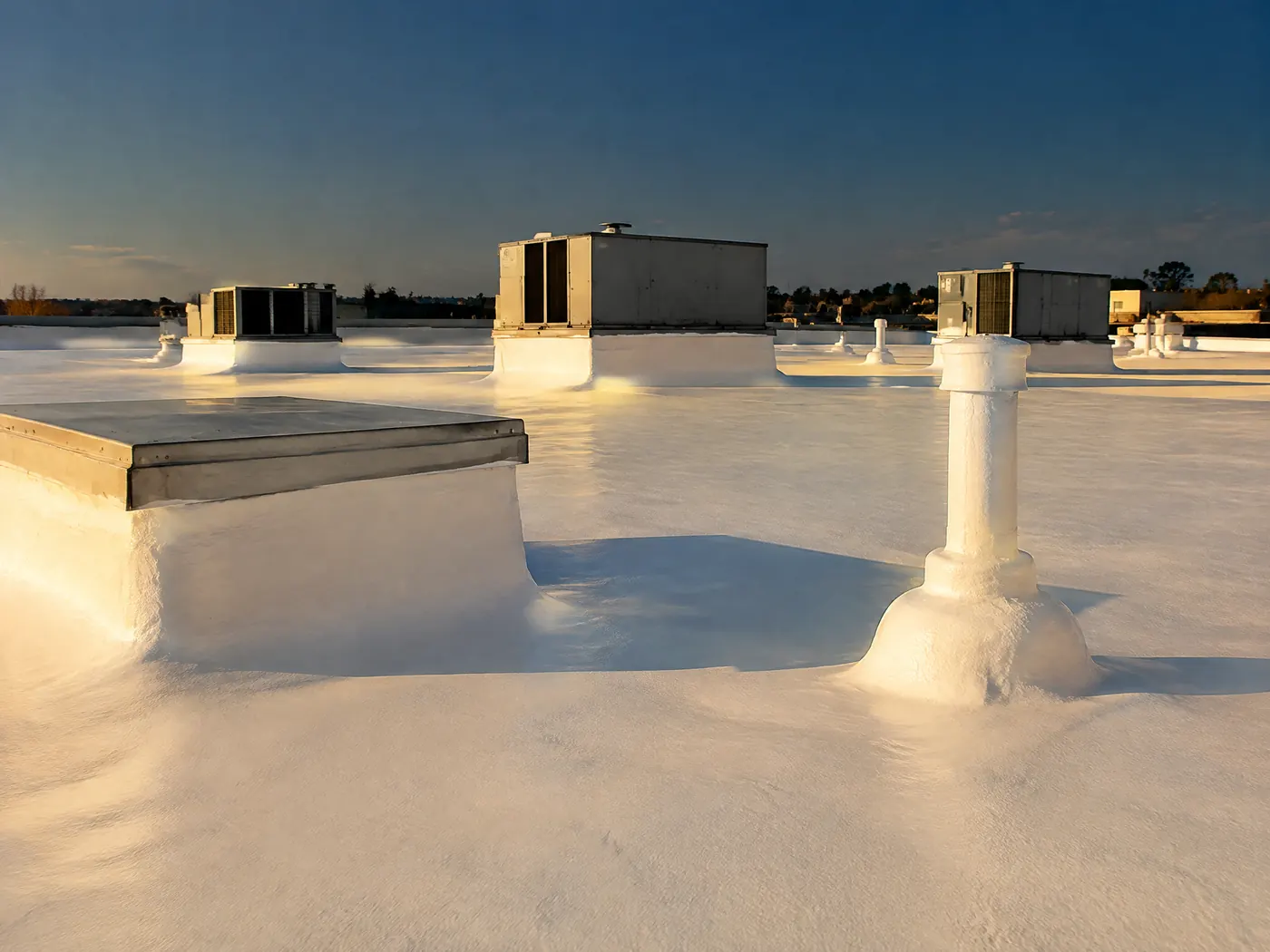
How is a spray foam roof built?
A spray foam roof is built in 3 layers: a prepared substrate, closed-cell polyurethane foam sprayed to the specified thickness and slope, and an elastomeric coating that protects the foam from UV.
Prepare
Wet insulation is removed, the surface is cleaned and fastened, and loose material is taken out.
Spray foam
Foam is applied in passes, building thickness and tapering toward drains to remove low spots.
Coat
Silicone, acrylic or urethane coating is applied over the foam the same day or soon after.
Granules where needed
Embedded granules add traction and impact resistance on walkways.
What are the advantages of a seamless foam roof?
A foam roof has 0 seams, because the foam is sprayed as 1 continuous layer that bonds to the substrate and flows around every penetration and curb.
- No laps or welds to open with age.
- Penetrations and curbs are sealed by the foam itself.
- Slope can be built into the foam to correct ponding.
- Lightweight compared with ballasted or multi-ply systems.
- Often applied over an existing dry roof, avoiding tear-off.
How much insulation does roofing foam add?
Closed-cell roofing foam is commonly rated at roughly R-6 per inch, so 2 inches adds about R-12 and 3 inches about R-18 on top of any insulation already in the roof.
Based on roughly R-6 per inch for closed-cell roofing foam. Product data sheets give exact values.
How often does a foam roof need recoating?
A foam roof typically needs recoating every 10 to 20 years, depending on coating type and thickness, and each recoat starts another service cycle without removing the foam.
| Coating | Typical recoat interval | Surface prep at recoat | Notes |
|---|---|---|---|
| Acrylic | About 10 to 15 years | Clean, prime as needed | Best on well-drained foam |
| Silicone | About 10 to 20 years | Clean; recoat with silicone | Tolerates ponding, collects dirt |
| Urethane | About 10 to 15 years | Clean and scuff | Tough under foot traffic |
What conditions does spray foam need during application?
Spray foam needs 3 conditions to cure properly: a dry substrate, surface and air temperatures inside the manufacturer range, and low wind so overspray stays on the roof.
- Moisture: foam sprayed over a damp surface loses adhesion and can blister, so morning dew must burn off first.
- Temperature: cold surfaces slow the reaction and reduce yield, while very hot surfaces can make the foam rise unevenly.
- Wind: crews use wind screens and stop spraying in gusts, protecting parked cars, windows and rooftop equipment from overspray.
- Pass thickness: foam goes down in lifts, commonly around 1/2 inch or more each, so heat from the reaction can escape.
- Coating timing: the coating follows soon after spraying, before UV can begin to degrade the foam surface.
Spray foam is where Dura-Foam began in 1983, and the crews who apply it read these conditions every morning before the first pass. Getting surface prep, lift thickness and coating timing right is what separates a foam roof that lasts decades from 1 that blisters in its first summer.
Why is a foam roof renewable rather than replaceable?
A foam roof is renewable because the 1 component that wears out, the coating, can be cleaned and recoated, while the foam beneath keeps insulating as long as it stays dry and protected.
The risk is neglect. Once the coating erodes and UV reaches the foam, the surface degrades and water can enter. Blisters, bird pecking and mechanical damage also open the foam. Inspections twice a year catch those spots while they are small, and our scan confirms the foam and the roof below it are dry before any recoat; the scan method is covered on commercial roof inspections.
FAQs
What is spray foam roofing for commercial buildings?
A seamless roof made by spraying closed-cell polyurethane foam and protecting it with a coating.
What is SPF roofing?
SPF stands for spray polyurethane foam, the same system.
Can foam go over my existing roof?
Often, if the existing roof is dry and sound. The scan confirms it.
How long does a foam roof commercial system last?
With recoating every 10 to 20 years, a well-maintained foam roof can stay in service for decades.
Does foam fix ponding?
Foam can be tapered during application to move water toward drains.
Is spray foam roofing energy efficient?
Yes. Foam adds about R-6 per inch, and reflective coatings reduce heat gain.
What damages a foam roof?
UV once the coating wears through, birds, foot traffic and mechanical damage.
How is a foam roof repaired?
Damaged foam is cut out, refilled with foam or sealant, and recoated.
Is foam heavy?
No. It is one of the lightest roof systems.
How long has Dura-Foam worked with spray foam?
Since 1983.
Can foam roofs be on a program?
Yes. Twice-yearly inspections protect the coating between recoats.
How do I get a foam roof quote?
Request a roof scan or call (310) 647-7192.
Renew your roof instead of tearing it off.
Trusted since 1983 on over 20,000 commercial roofs. California License 435836.