Commercial roof preventative maintenance
Commercial Roof Preventative Maintenance on Flat and Low-Slope Roofs
Commercial roof preventative maintenance means visiting a flat roof 2 times a year, in spring and fall, to keep 6 areas sound: drainage, penetrations, HVAC curbs, flashing, seams and debris.
Each visit corrects small defects before water reaches the insulation or the interior.
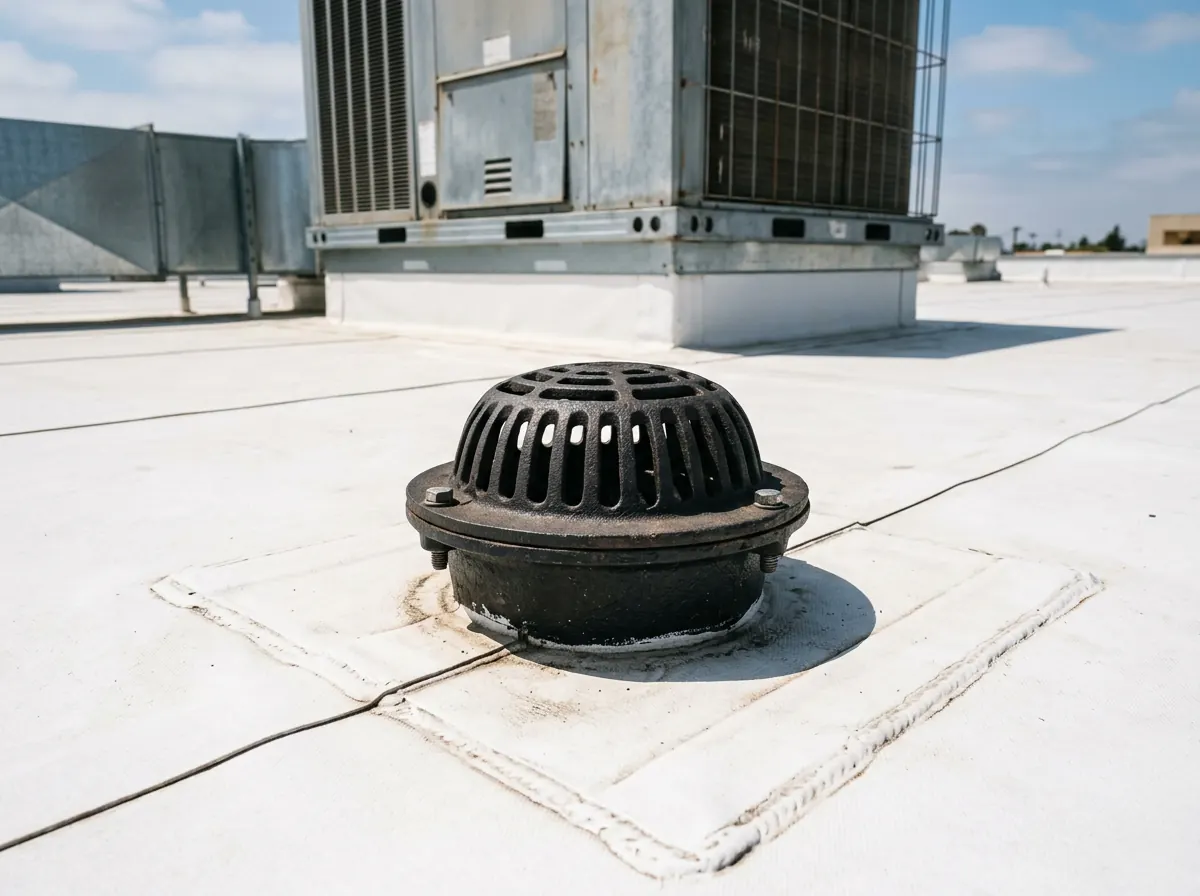
Why does a commercial roof need preventative maintenance?
A commercial roof needs preventative maintenance because 1 small defect left through a rain season can wet the insulation below the membrane, and wet insulation turns a repair into a section replacement.
Flat roofs drain slowly, so water has time to find any opening. The benefits of commercial roof maintenance come from closing those openings early:
- Repairs stay small and inexpensive because they are found early.
- Insulation stays dry, so the roof keeps its thermal value.
- Tenants and operations avoid interior leaks and shutdowns.
- Dated records support warranty and insurance documentation.
- The Estimated Remaining Service Life is protected rather than shortened.
Travelers recommends semi-annual inspections and inspections after major storms. Chubb advises inspections generally twice a year.
What are the 6 areas of preventative maintenance on a flat roof?
The 6 areas of preventative maintenance on a flat roof are drainage, penetrations, HVAC curbs, flashing, seams and debris, and each one is a place where water commonly gets into the roof assembly.
| Area | What commonly fails | Preventative work |
|---|---|---|
| Drainage | Clogged strainers, blocked scuppers, ponding at low spots | Clear outlets, replace strainers, record ponding |
| Penetrations | Cracked pipe boots, empty pitch pockets, open sealant | Reseal, refill pitch pockets, replace boots |
| HVAC curbs | Split corners, loose counterflashing, condensate damage | Re-seal curb flashing, correct condensate discharge |
| Flashing | Pulled terminations at parapets, open laps, loose coping | Re-secure termination bars and coping, seal laps |
| Seams | Open welds or laps on TPO, PVC, EPDM and modified bitumen | Probe, re-weld or re-seal open sections |
| Debris | Leaves, trash, abandoned parts and loose fasteners | Remove debris, flag punctures for repair |
Why is drainage the 1st priority in flat roof maintenance?
Drainage is the 1st priority in flat roof maintenance because standing water adds weight, speeds membrane aging and pushes water through any open seam or penetration nearby.
Every visit starts at the drains. Strainers are checked and replaced if missing, outlets are cleared, and scuppers and overflow paths are opened. Ponding is recorded with photos so the pattern can be compared visit to visit. Persistent ponding near a drain or curb is flagged for correction, because a low spot does not fix itself.
How do penetrations, HVAC curbs and flashing fail on a commercial roof?
Penetrations, HVAC curbs and flashing fail on a commercial roof through 3 kinds of movement: thermal expansion, equipment vibration and service traffic, all of which open sealant joints and pull terminations loose over time.
Pipe boots crack in the sun. Pitch pocket filler shrinks and leaves a gap. HVAC technicians set panels and tools on the membrane and open curb corners. Parapet flashing pulls away where the wall moves differently from the deck. Each of these is a minutes-long repair when it is found on a scheduled visit, and a ceiling replacement when it is found by a tenant.
- Pipe boots and clamps checked and replaced where cracked.
- Pitch pockets topped up and resealed.
- Curb corners and counterflashing re-sealed.
- Termination bars, coping and edge metal re-secured.
How does preventative maintenance find problems below the membrane?
Preventative maintenance finds problems below the membrane with 1 tool a visual walk cannot replace: our non-destructive moisture survey, which maps trapped water in the insulation without core cuts.
A visual walk sees the surface. Our robotic, AI-assisted scan reads below it and produces a Moisture Map and a Deficiency Map, so wet areas can be repaired in place before they spread. The item-by-item list we work through on each visit is on the preventative maintenance checklist, and the visit schedule for each level is on what each plan includes.
More on commercial roof maintenance
FAQs
What is commercial roof preventative maintenance?
Commercial roof preventative maintenance is scheduled care of a flat roof, usually twice a year, that keeps drainage, penetrations, HVAC curbs, flashing and seams sound and the roof free of debris.
Is it preventive or preventative maintenance?
Both words mean the same thing. Preventive roof maintenance and preventative roof maintenance describe the same scheduled care.
How often should preventative maintenance be done?
Twice a year, in spring and fall, plus after major storms. Insurers such as Travelers and Chubb recommend inspections twice a year.
What is the most common cause of flat roof leaks?
Leaks most often start at drains, penetrations, HVAC curbs, flashing and seams, which is why preventative work focuses on those points.
Does preventative maintenance extend roof life?
Correcting defects before water reaches the insulation protects the roof assembly, and the Estimated Remaining Service Life in each report shows the effect over time.
Do you clear roof drains?
Yes. Drains, strainers, scuppers and overflow paths are checked and cleared on every visit.
Do you repair what you find?
Light repairs are included within the allowance on Protect and Manage. Larger items are quoted in writing and approved by you first.
Can HVAC work damage the roof?
Yes. Service traffic, dropped panels and condensate discharge are common sources of curb and membrane damage.
Do you cut cores to check for moisture?
No. Our non-destructive moisture survey maps trapped water without core cuts or test squares.
Which roof systems do you maintain?
TPO, EPDM, PVC, spray polyurethane foam, modified bitumen and built-up flat and low-slope commercial roofs.
Does preventative maintenance help with warranties?
Manufacturers commonly place inspection, documentation and repair responsibilities on the owner, and scheduled maintenance produces those records. Requirements vary by manufacturer.
Start preventative maintenance before the next rain season.
Trusted since 1983 on over 20,000 commercial roofs. California License 435836.