Routine maintenance for commercial roofs
Commercial Roof Preventative Maintenance Checklist
Our commercial roof preventative maintenance checklist has 31 items in 8 groups, from the drains to the roof history, and we work through every item on every scheduled visit.
Print the page and use it as a guide to routine maintenance for commercial roofs. Only trained, protected personnel should go on a roof.
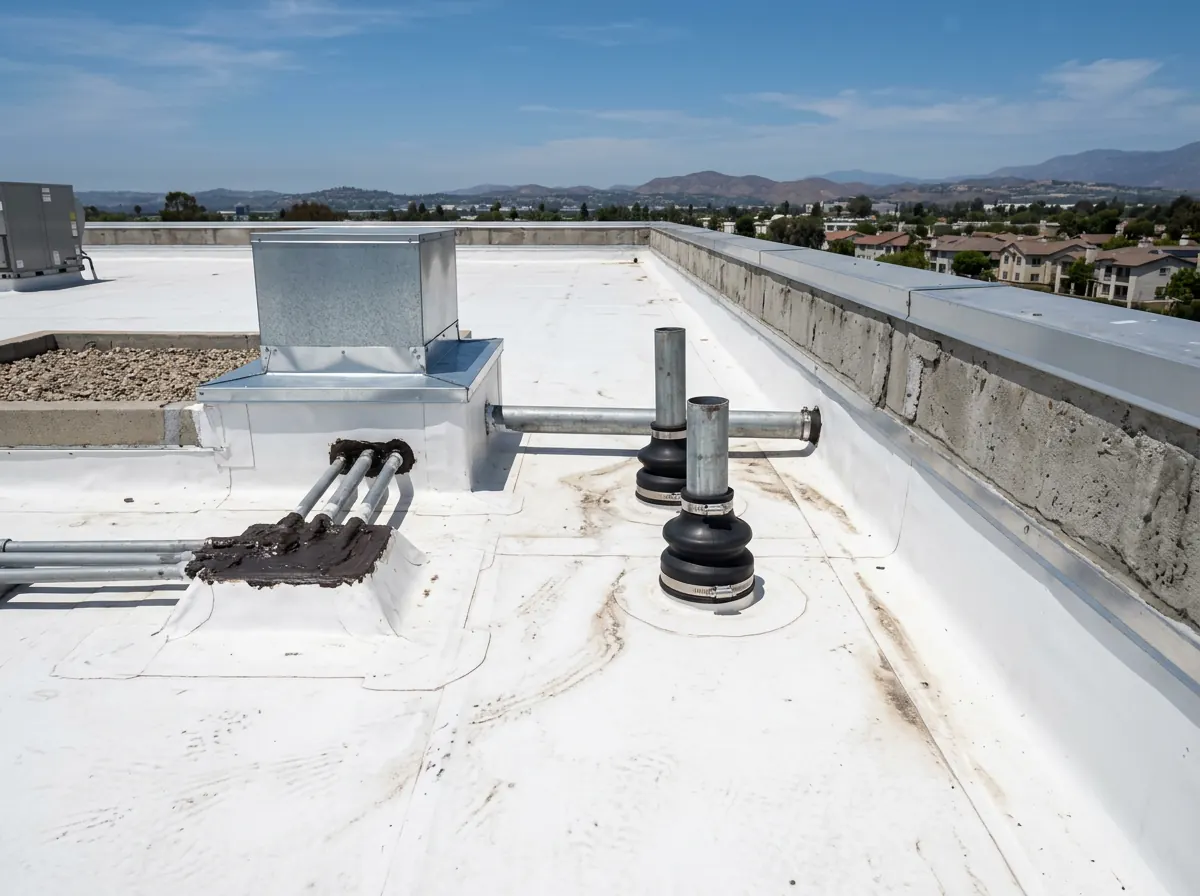
What is on a commercial roof preventative maintenance checklist?
A commercial roof preventative maintenance checklist lists 31 items in 8 groups: preparation, drainage, penetrations, HVAC curbs, flashing, seams, debris and the visit record.
Before going on the roof
- Review the last report, the Deficiency Map and any open repair items
- Check interior ceilings on the top floor for new stains or drips
- Confirm safe roof access: hatch, ladder or lift, and fall protection
- Note recent rooftop work by HVAC, solar or other trades
Drainage
- Every drain strainer present, secured and clear
- Drain outlets flowing, with no standing water at the bowl
- Scuppers, gutters and downspouts open and attached
- Overflow drains and overflow scuppers unobstructed
- Ponding areas photographed and compared with the last visit
Penetrations
- Pipe boots intact, clamps tight, no cracking
- Pitch pockets full, with no shrinkage gap
- Vents, exhaust stacks and conduit sealed at the base
- Abandoned penetrations capped and flashed
HVAC curbs and rooftop equipment
- Curb corners and counterflashing sealed
- Condensate discharging to a drain, not onto the membrane
- Equipment supports and dunnage seated, membrane under them intact
- Service panels, screws and tools removed from the roof surface
What does the checklist cover at the roof edge, seams and field?
At the roof edge, seams and field, the checklist covers 4 flashing items, 4 seam and field items and 3 housekeeping items, then 3 record-keeping steps after the visit.
Flashing and roof edge
- Parapet base flashing attached, with no gaps or bridging
- Termination bars fastened and sealed
- Coping and edge metal secure, joints sealed
- Expansion joints intact
Seams and roof field
- Seams and laps probed, with open sections marked
- Blisters, ridges, splits and soft spots recorded
- Punctures along walkways and service routes recorded
- Surface coating or granule loss noted
Debris and housekeeping
- Leaves, trash and loose materials removed
- Loose fasteners and metal scraps picked up
- Walkway pads in place on service routes
After the visit
- Light repairs completed and photographed before and after
- Items beyond the allowance photographed and quoted
- Visit added to the roof history for warranty and insurance records
How many items fall in each checklist group?
Drainage is the largest group with 5 of the 31 items, because standing water is the most common way a flat roof begins to fail.
How does a maintenance checklist differ from an inspection checklist?
A maintenance checklist adds 2 things an inspection checklist does not: corrective work done during the visit and a record of each repair for the roof history.
| Task | Visual inspection | Maintenance visit |
|---|---|---|
| Drains and scuppers | Observed | Cleared and strainers replaced |
| Open seams | Noted | Re-welded or re-sealed within the allowance |
| Penetrations | Noted | Resealed, pitch pockets refilled |
| Debris | Noted | Removed |
| Moisture below the membrane | Not visible | Mapped by our non-destructive moisture survey |
| Records | Notes and photos | Dated repair history with before and after photos |
The reasons behind each group are explained on commercial roof preventative maintenance.
How often should the checklist be completed?
The checklist should be completed 2 times a year, in spring and fall, and again after any major storm, which matches the semi-annual schedule Travelers and Chubb recommend.
Monitor includes 1 scheduled visit a year. Protect and Manage include 2 scheduled visits plus post-storm visits, and Manage adds annual low-pressure cleaning. The schedule for each level is on what each plan includes.
More on commercial roof maintenance
FAQs
What should a commercial roof maintenance checklist include?
Drainage, penetrations, HVAC curbs and rooftop equipment, flashing and roof edge, seams and field, debris, and a record of every repair.
Can I use this checklist myself?
You can use it as a guide. Roof work should only be done by trained personnel with safe access and fall protection.
How often should the checklist be used?
Twice a year, in spring and fall, and after major storms.
What is the most important item?
Drainage. A blocked drain causes standing water, and standing water finds any open seam or penetration nearby.
Why check interior ceilings first?
A new stain on the top floor points to where water is entering, which helps target the roof walk.
Why does the checklist include HVAC condensate?
Condensate discharged onto the membrane holds water against it and can damage some roof surfaces over time.
What happens to items beyond the repair allowance?
They are photographed and quoted in writing, and work starts only after you approve it.
Does the checklist find wet insulation?
A visual checklist cannot see below the membrane. Our non-destructive moisture survey maps trapped water separately.
Is the checklist the same for every roof type?
The groups are the same. Seam checks differ by system, such as welded seams on TPO and PVC and laps on EPDM and modified bitumen.
Should I keep completed checklists?
Yes. Dated records support warranty and insurance documentation and show how the roof is changing.
Have every item on the checklist done for you.
Trusted since 1983 on over 20,000 commercial roofs. California License 435836.