Industrial roof maintenance
Industrial Roof Maintenance for Plants That Never Stop
Industrial roof maintenance deals with 4 conditions most commercial roofs never see: process exhaust, chemical fallout, heavy rooftop equipment and operations that run 24 hours a day.
Our robotic, AI-assisted scan works on the roof surface, so production below keeps running while the roof is mapped.
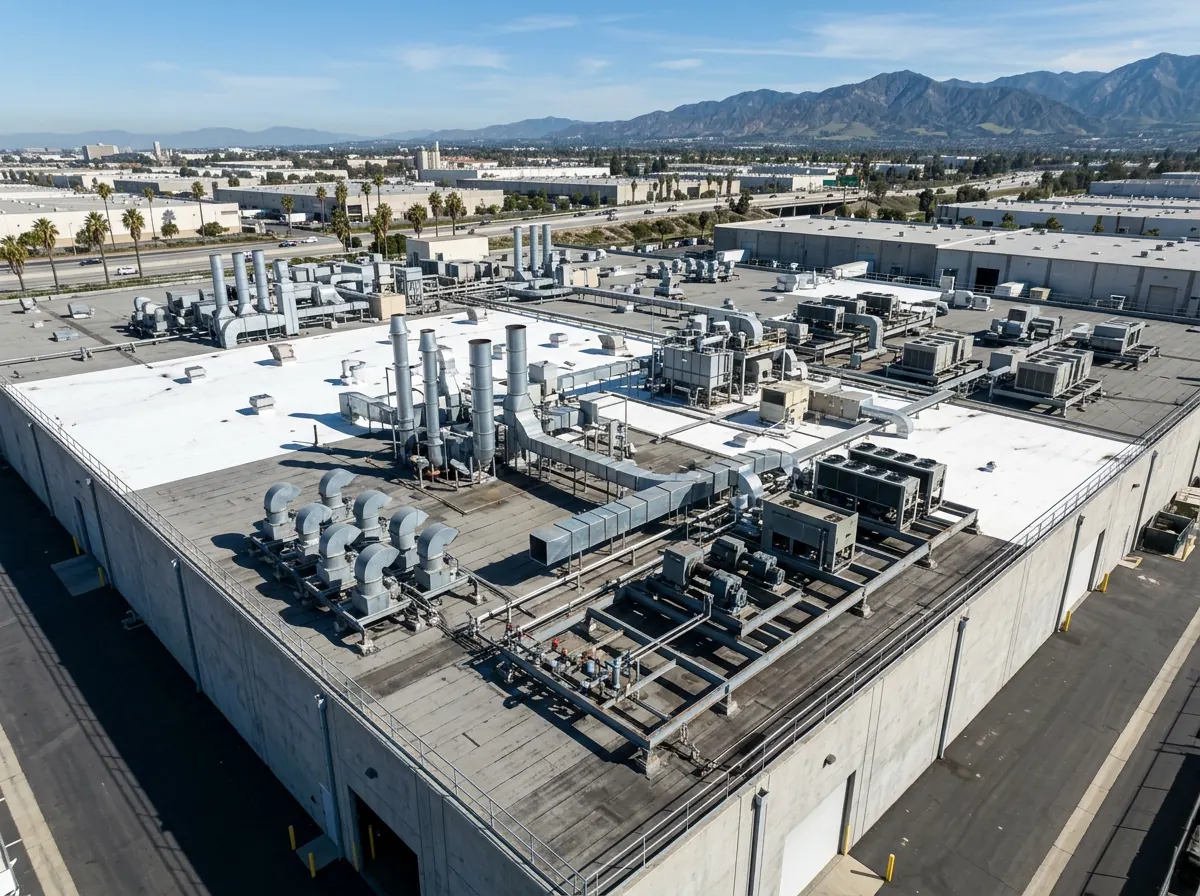
Which 4 industrial conditions shorten roof life fastest?
Process exhaust, chemical fallout, heavy rooftop equipment and continuous operation are the 4 industrial conditions that wear a roof faster than an ordinary commercial building.
| Condition | Effect on the roof | What maintenance does |
|---|---|---|
| Process exhaust | Heat and residue around stacks soften and stain the membrane | Checks stack flashing, collars and the membrane around each outlet |
| Chemical fallout | Oils, solvents and particulates attack some membranes | Records deposits, cleans affected areas, flags incompatible surfaces |
| Heavy rooftop equipment | Point loads, vibration and punctures at supports | Checks dunnage, sleepers, curbs and the membrane beneath them |
| Continuous operation | Little downtime for roof work, constant contractor traffic | Schedules work around shifts, logs access, protects traffic paths |
How does process exhaust damage an industrial roof?
Every exhaust stack is 1 more penetration exposed to heat, moisture and residue, and the flashing and membrane within a few feet of each outlet age faster than the rest of the field.
Grease, oil mist and condensate from exhaust collect on the membrane and hold moisture. Heat cycles open collars and storm bands. Residue also hides small splits until water reaches the insulation.
- Stack flashing, collars and storm bands checked on each visit.
- Residue cleaned from the membrane around outlets.
- Wet insulation near stacks found with our non-destructive moisture survey.
- Discolored or softened membrane recorded on the Deficiency Map.
What does chemical fallout do to a roof membrane?
Chemical fallout settles across the full roof area, and 1 incompatible substance, such as oil on certain membranes, can swell, soften or embrittle the surface over time.
The right response depends on the membrane. TPO, EPDM, PVC, spray polyurethane foam, modified bitumen and built-up roofs each react differently to oils, solvents and particulates. Maintenance records which areas are affected and how they change between visits.
Cleaning removes deposits before they hold water against the surface. Manage includes annual low-pressure roof cleaning.
How do heavy rooftop units and continuous operation change maintenance?
Heavy units concentrate load at a few support points, and plants running 3 shifts leave no quiet hours, so maintenance focuses on supports and is scheduled around production.
- Dunnage, sleepers and equipment curbs checked for movement and flashing gaps.
- Membrane under and around supports checked for punctures and crushing.
- Vibration damage at pipe supports and conduit recorded.
- Visits scheduled around shift changes, shutdowns and safety requirements.
- Every contractor visit to the roof logged so damage can be traced.
A dedicated account manager on Protect and Manage coordinates access with your plant team. Manage adds a guaranteed leak response within 24 hours.
What does industrial roof maintenance cost per year?
A 120,000 square foot industrial roof costs $14,400 to $18,000 a year on Monitor, $26,400 to $30,000 on Protect and $48,000 to $54,000 on Manage, from our published rates.
120,000 sq ft multiplied by $0.12 to $0.15, $0.22 to $0.25 and $0.40 to $0.45 per square foot per year.
Repairs beyond the plan allowance and work on process equipment are quoted separately. Rates and inclusions are on maintenance programs and pricing.
More on commercial roof maintenance
FAQs
What is industrial roof maintenance?
Scheduled inspection, cleaning and light repair of a manufacturing or process facility roof, with attention to exhaust, fallout and heavy equipment.
Can you work on the roof while the plant runs?
Yes. The scan works on the roof surface, and maintenance visits are scheduled around shifts and safety requirements.
How often should an industrial roof be inspected?
Twice a year, in spring and fall, plus after major storms. Roofs with heavy exhaust or fallout benefit from Manage cleaning as well.
Do you inspect exhaust stack flashing?
Yes. Stack flashing, collars and storm bands are checked on every visit.
Can chemical fallout void a roof warranty?
Some manufacturer warranties exclude chemical damage. Check your warranty terms, and keep records of cleaning and inspections.
Do you repair rooftop equipment?
No. We maintain the roof around and under equipment. Repairs to the equipment itself go to your mechanical contractor.
Is light repair included?
Protect includes up to $1,500 a year of light repairs and Manage up to $2,500. Larger repairs are quoted and approved first.
How much does industrial roof maintenance cost?
From $0.12 to $0.45 per square foot per year depending on the plan, with minimums of $1,500, $2,500 and $4,500.
Do you find wet insulation under industrial roofs?
Yes. Our non-destructive moisture survey maps trapped water without cutting cores.
Which industrial roof systems do you maintain?
TPO, EPDM, PVC, spray polyurethane foam, modified bitumen and built-up roofs on flat and low-slope buildings.
Can multiple plant buildings share one plan?
Yes. Portfolio programs place every roof on one schedule and one report format.
Schedule a scan of your industrial roof.
Trusted since 1983 on over 20,000 commercial roofs. California License 435836.