Medical and office
Medical and Office Building Roof Inspection and Maintenance
A single drip over an operating room or a server rack can cost more than 1 full year of roof maintenance, and in a medical building it can also trigger an infection control event.
We find wet areas before they reach a ceiling, quietly and without opening the roof.
Which rooms under a roof carry the most risk in a medical or office building?
At least 5 room types carry outsized risk under a roof: operating and procedure rooms, sterile storage, imaging suites, server rooms and executive or client floors.
| Room type | Roof risk | Precaution |
|---|---|---|
| Operating and procedure rooms | Drip or ceiling stain halts cases | Scan above first, schedule work after hours |
| Sterile processing and storage | Moisture contaminates supplies | Containment and moisture checks above the space |
| Imaging suites | Water near costly equipment | Prioritize wet areas found above the suite |
| Server and telecom rooms | Outage from a single leak | Inspect penetrations and drains above the room |
| Lobbies and client floors | Visible stains and tenant complaints | Repair during off-hours with quiet methods |
How does infection control change roof work on a medical building?
Infection control changes roof work in 3 ways: it limits dust and debris entering the building, it protects air intakes, and in hospitals it typically requires an infection control risk assessment before work begins.
Infection control steps on a medical roof
- Coordinate with the facility infection prevention team before work.
- Keep debris and dust away from open intakes and hatches.
- Close or filter intakes near active work when the facility approves.
- Seal interior access points used to reach the roof.
- Document the work area and cleanup at the end of each day.
The scan itself creates no dust and makes no openings, which is why it fits sensitive buildings well.
Why do odor and noise limits matter for office and clinic roofs?
Odor and noise limits matter because rooftop air intakes can pull fumes from adhesives or hot work into occupied rooms within 1 or 2 minutes, and roof noise carries into top-floor offices and exam rooms.
- Low-odor adhesives and cold-applied systems reduce complaints near intakes.
- Loud work such as tear-off is scheduled for evenings or weekends.
- Intake locations are mapped before any work begins.
- Tenants and staff are notified of work days in advance.
How does dense rooftop mechanical affect roof condition?
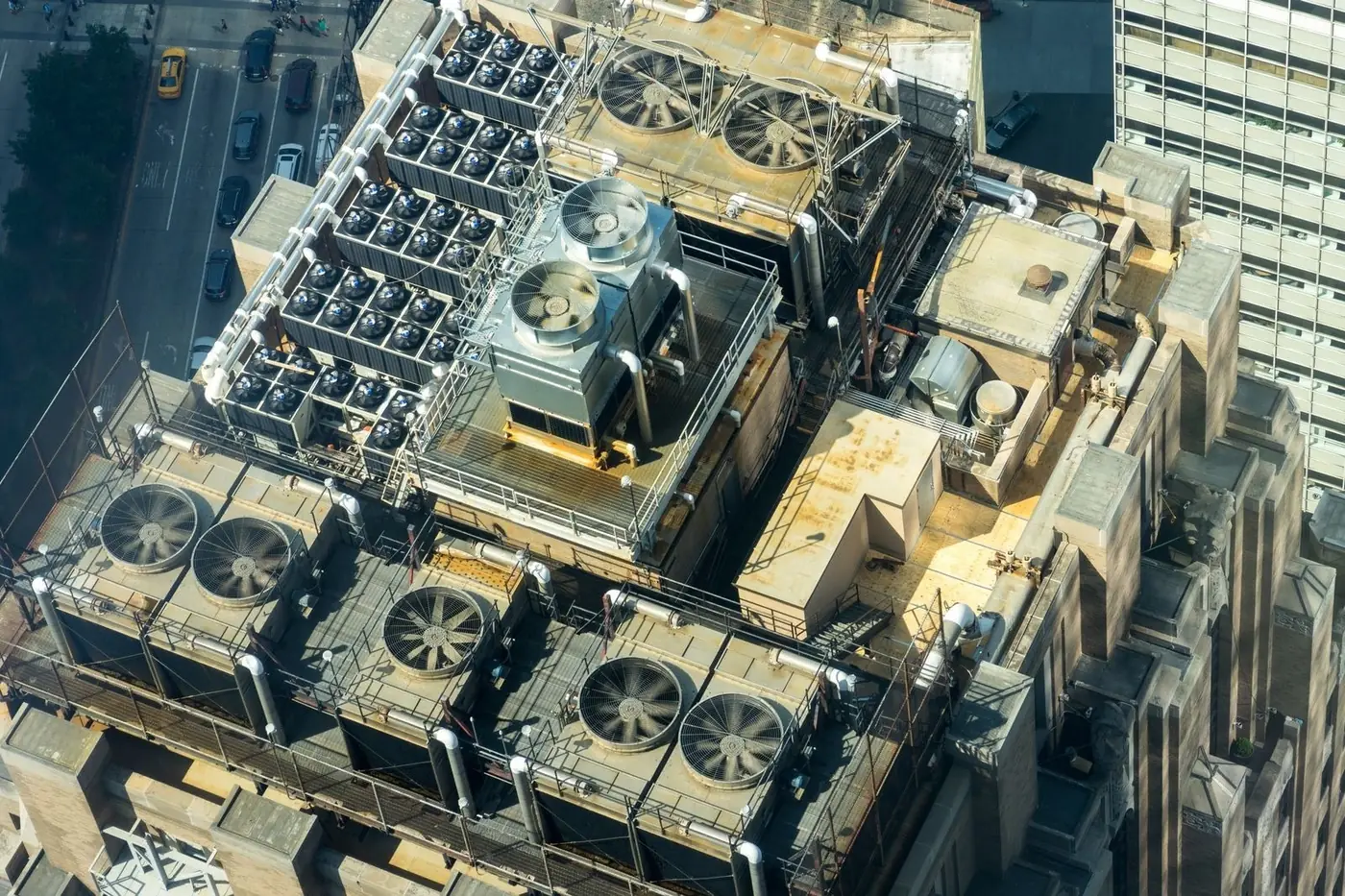
Dense mechanical can put dozens of penetrations, curbs and pipe supports on 1 roof, and every one is a seam that can fail and a place where service crews walk and drop tools.
Medical and office buildings carry heavy cooling loads, backup power, exhaust fans and medical gas or vacuum equipment. Leaks start most often at curbs, pipe penetrations and condensate lines, then travel along the deck before showing inside, which makes the interior stain a poor guide to the source. Our Moisture Map traces wet insulation back toward its origin. Walkway pads along service routes cut membrane damage from HVAC crews.
What the scan records at each penetration is covered in what happens during a scan.
How much downtime can a roof leak cause in a medical office?
A roof leak over clinical space can close a room for 1 day for a minor drip and for several weeks when wet ceilings, drywall or insulation must be removed under containment.
Example ranges only. Actual closure depends on the facility, the damage and local requirements.
FAQs
Is the scan quiet enough for an occupied clinic?
Yes. The scan is quiet, creates no dust and makes no openings in the roof.
Do you need access to patient areas?
No. We need roof access only, usually by ladder or hatch.
Can you work after hours?
Yes. Repairs near intakes or over sensitive rooms are often scheduled for evenings or weekends.
Do you follow hospital infection control rules?
Yes. We coordinate with the facility infection prevention team and follow its requirements.
Can you find the source of a leak over a server room?
The Moisture Map shows wet insulation and helps trace water back toward its entry point.
Which roofs are common on office buildings?
Built-up, modified bitumen, TPO, PVC and spray foam are all common on office roofs.
Is the report stamped by an engineer?
Yes. A licensed Professional Engineer signs and stamps every report.
How fast is the report?
Within 48 hours of the scan.
Do you handle multi-tenant office buildings?
Yes. The report can be shared with tenants or lenders as needed.
How often should a medical office roof be inspected?
At least twice a year, plus after major storms and after rooftop equipment work.
How do I request a scan?
Request a roof scan or call (310) 647-7192.
Keep water away from the rooms that cannot afford it.
Trusted since 1983 on over 20,000 commercial roofs. California License 435836.