Shopping center roof maintenance
Retail Building Roof Management for Shopping Centers
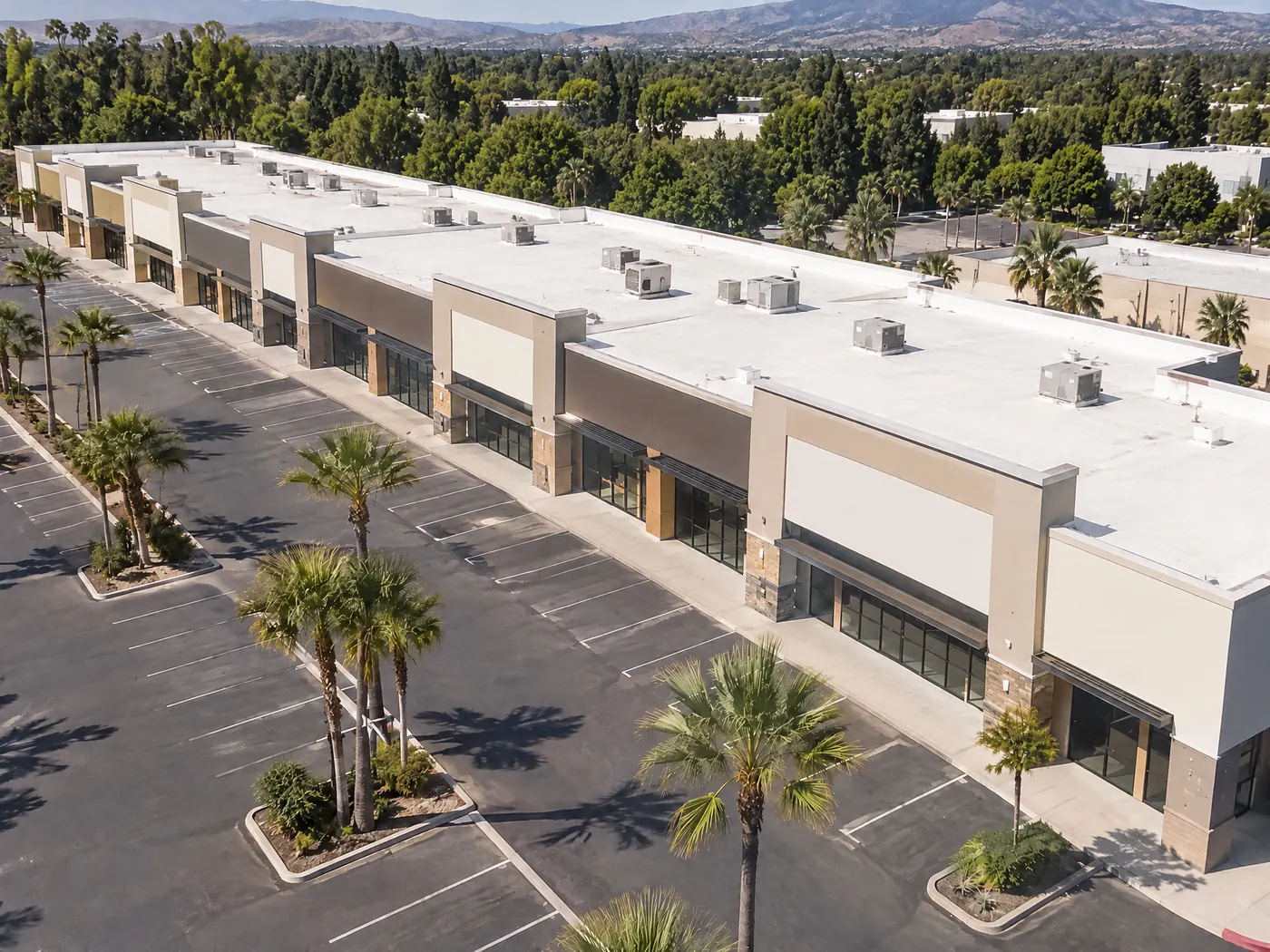
Retail building roof management treats each shopping center as a set of roof sections over separate tenants, so 1 leak is handled as a tenant issue, a lease issue and a roof repair at the same time.
Work is scheduled around trading hours, and every cost is documented for CAM reconciliation.
Why is a retail roof leak a tenant problem first?
A leak over 1 occupied suite can close a sales floor, damage stock and trigger a written complaint under the lease before anyone has reached the roof.
- Ceiling stains and buckets on a sales floor are visible to shoppers.
- Damaged inventory becomes a claim discussion between tenant and landlord.
- Repeat leaks give a tenant leverage at renewal.
- A Moisture Map shows which suites sit under wet insulation before a leak appears.
What happens when water reaches an occupied suite?
A leak over an occupied suite is handled in 5 steps, starting with stopping water entry and ending with a written record property management can share with the tenant.
Stop the water
A temporary repair at the entry point, located from the roof plan and the suite below.
Trace the source
Water often travels along the deck, so the entry point can sit several bays away from the ceiling stain.
Check the insulation
Wet insulation around the entry point is mapped so it is not left to feed the next leak.
Permanent repair
Scoped and priced in writing, then completed outside store hours where needed.
Close the record
Photos, cause and cost sent to property management for the tenant file.
Manage members receive 24-hour leak response. Tenants usually care less about the membrane than about whether the same ceiling will leak again, and a mapped, documented repair is the most direct answer to that question.
Who is responsible for the roof, landlord or tenant?
Responsibility is set by each lease, and in most multi-tenant centers the landlord maintains the roof and recovers part of the cost through 1 shared CAM pool.
| Lease type | Who maintains the roof | Who pays |
|---|---|---|
| Multi-tenant NNN | Landlord | Tenants through CAM, as the lease allows |
| Single-tenant NNN | Often the tenant | Tenant directly |
| Modified gross | Landlord | Landlord, with some costs passed through |
| Gross | Landlord | Landlord |
| Ground lease | Tenant | Tenant |
How does roof documentation support CAM recovery?
Each work order carries 4 records (location, photos, materials and cost), which gives tenants an itemized basis for roof charges at the annual CAM reconciliation.
- Routine maintenance visits and small repairs are commonly recoverable where the lease allows.
- Capital replacement is often treated differently, sometimes amortized or excluded.
- Damage caused by a tenant contractor at a rooftop unit can be documented and charged to that tenant.
- Section-level costs help allocate charges when tenants share a roof.
Every lease is different, so the records are built to support whatever split your leases set. Planning the capital side is covered on roof capital planning.
How is roof work scheduled around store hours?
Scans run at about 50,000 square feet an hour from the roof surface, and noisy or odorous repairs over occupied suites are booked before opening or after closing.
Notify
Property management tells affected tenants the date and time window.
Protect
Rooftop access is kept away from storefronts and customer paths.
Work
Repairs over trading suites happen outside store hours where the lease or tenant requires it.
Report
Photos and costs go to property management the same week.
Why do shopping centers need section-by-section scores?
A center built in 3 phases often has 3 or more roof ages, so 1 overall rating hides the section that will fail first.
Example data for illustration. Each section receives its own score, repair cost and remaining life.
What does a retail roof program cost?
A 150,000 square foot center costs $33,000 to $37,500 a year on Protect, at $0.22 to $0.25 per square foot.
Monitor and Manage rates and minimums are on maintenance programs and pricing.
More on roof asset management
FAQs
What is retail building roof management?
Scanning, maintaining and documenting the roofs of shopping centers and retail buildings as managed assets.
What does shopping center roof maintenance include?
Scheduled visits, drain and seam work, rooftop unit curb checks, leak response and itemized records.
Can you work at night?
Yes. Repairs over occupied suites can be scheduled before opening or after closing.
Does the scan disturb tenants?
The scan runs on the roof surface with no core cuts or holes, so suites below stay open.
Can roof costs be split by tenant?
Work orders are located by roof section, which helps property management allocate costs as leases allow.
Do you handle anchor stores and pad buildings?
Yes. Each building or section is scored and reported separately.
What about tenant rooftop equipment?
Curbs and penetrations for tenant units are inspected, and damage is documented for the responsible party.
How quickly are leaks answered?
Manage includes 24-hour leak response.
Can a center with several owners join?
Each owner can contract for its own parcels while sharing the same report format.
Which roof types are common on retail centers?
TPO, modified bitumen, built-up, PVC and spray foam, often several on one site.
How do I start?
Request a roof scan or call (310) 647-7192.
Keep tenants open and roof costs documented.
Trusted since 1983 on over 20,000 commercial roofs. California License 435836.