Central Coast
Commercial Roof Inspection and Maintenance in Santa Cruz County
Santa Cruz County covers about 445 square miles between the Santa Cruz Mountains and Monterey Bay, with 4 cities and a commercial base split between Watsonville food plants, Scotts Valley tech offices and beach town retail. Our scan tells you which of those roofs is quietly soaking up winter rain.
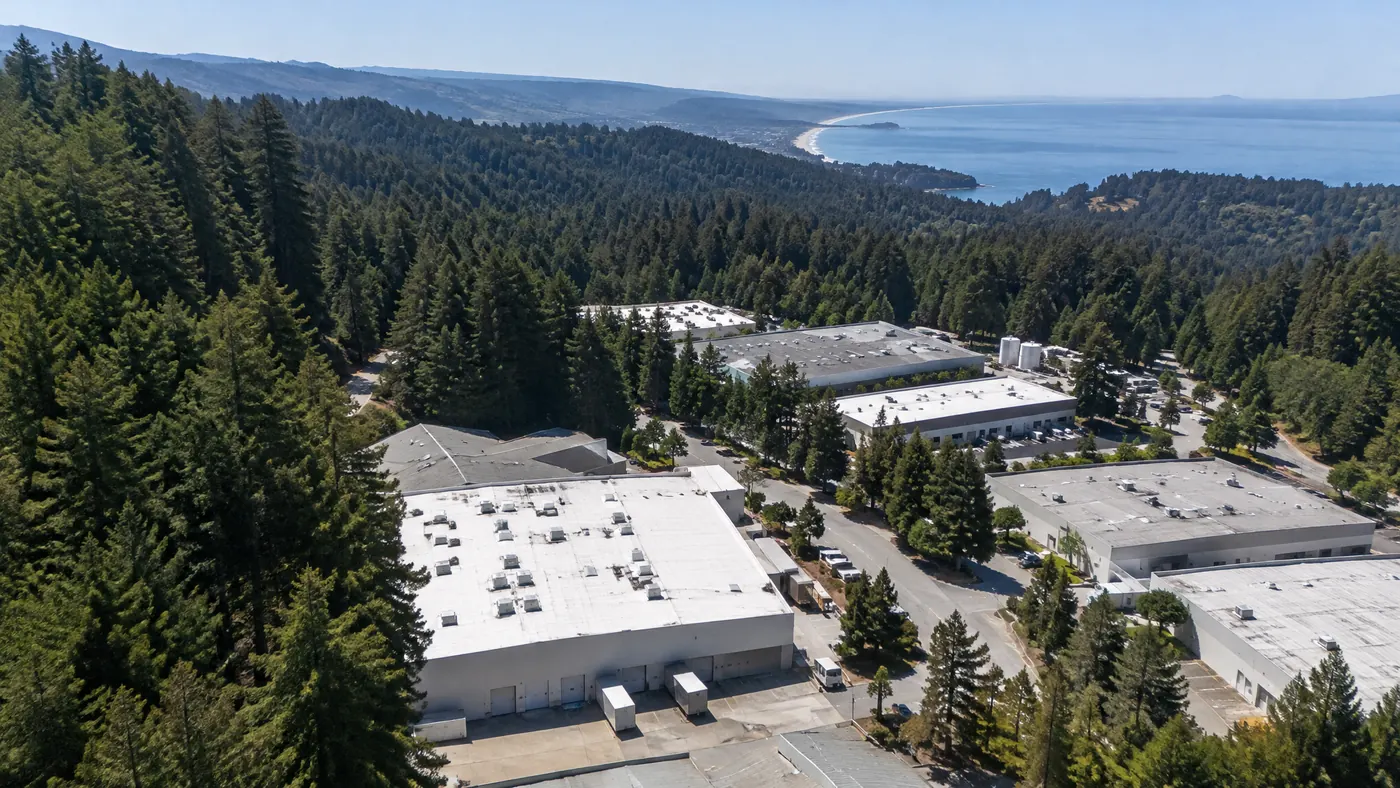
What kinds of commercial buildings are in Santa Cruz County?
Santa Cruz County flat roofs fall into 4 groups: food processing and cold storage in Watsonville, office and light industrial buildings in Scotts Valley, university and civic buildings in Santa Cruz, and retail and hospitality along the coast.
Watsonville sits in the Pajaro Valley, one of the busiest berry and vegetable growing areas in the state, and its industrial west side is full of coolers and processing plants.
Scotts Valley grew around technology firms in the 1980s and still carries office and flex buildings off Highway 17. Capitola, Soquel and Aptos lean on retail centers, medical offices and restaurants.
- West Watsonville industrial area: berry coolers, cold storage and food processing near the airport and Highway 1
- Scotts Valley business parks: office, flex and light industrial buildings along Highway 17
- Harvey West and the Westside of Santa Cruz: light industrial, maker and service buildings
- 41st Avenue and Capitola: retail centers, a regional mall and medical offices
- Aptos and Soquel: medical, retail and small office buildings
| Building type | Common roof system | Typical age | What Santa Cruz County does to it |
|---|---|---|---|
| Berry cooler or cold storage building | Spray foam or insulated TPO | 10 to 30 years | Condensation and heavy refrigeration gear |
| Scotts Valley office or flex building | Modified bitumen or TPO | 20 to 40 years | Redwood needles and shade-trapped moisture |
| Westside light industrial building | Built-up or modified bitumen | 30 to 50 years | Old patches and soft decks |
| Capitola retail center | Modified bitumen or PVC | 15 to 30 years | Salt air and tenant changes |
| Civic or university building | PVC or built-up | 15 to 40 years | Long winter rain and moss |
What does the Santa Cruz County climate do to a flat roof?
Santa Cruz County roofs take some of the heaviest winter rain on the California coast, with the mountains above Scotts Valley and Ben Lomond often receiving more than 40 inches a year.
Shaded roofs under redwoods and oaks stay wet for days after a storm and grow moss and algae on seams. Needles, leaves and cones pile into drains, while coastal roofs in Capitola and Santa Cruz deal with fog and salt air on metal and fasteners.
How often should commercial roofs in Santa Cruz County be inspected?
Commercial roofs in Santa Cruz County should be inspected 2 times a year, and roofs under trees need drains cleared every 3 months through fall and winter.
A single blocked drain during an atmospheric river storm can put inches of water on a flat roof in a few hours. Our commercial roof inspection page explains what each visit covers.
What does a maintenance program cost in Santa Cruz County?
A maintenance program for a 50,000 square foot food processing plant in Santa Cruz County costs $11,000 to $12,500 a year on our Protect program, priced at $0.22 to $0.25 per square foot with a $2,500 minimum.
Protect fits most Santa Cruz County roofs, because long wet winters punish any skipped repair. Owners with one small retail building often start on Monitor, and food processors with several coolers sometimes move to Manage. Compare all 3 tiers for Santa Cruz County on the maintenance programs and pricing page.
Santa Cruz County figures use our published rates: Monitor $0.12 to $0.15 per square foot a year with a $1,500 annual minimum, Protect $0.22 to $0.25 per square foot a year with a $2,500 annual minimum, Manage $0.40 to $0.45 per square foot a year with a $4,500 annual minimum.
How soon can you scan a roof in Santa Cruz County?
We can scan a roof in Santa Cruz County as soon as roof access is confirmed after your request, and a 50,000 square foot food processing plant takes about an hour at roughly 50,000 square feet an hour, with the PE-stamped report delivered within 48 hours.
Highway 17 traffic shapes Scotts Valley scheduling, so we book early starts, and Watsonville coolers are scanned around harvest loading. Book your Santa Cruz County scan through our roof scan request form, or compare counties on the service areas page.
Which Santa Cruz County cities and business districts do you serve?
We serve all of Santa Cruz County, and the 7 cities and districts below are where most of its flat commercial roofs sit.
- Watsonville: food processing, cold storage and agricultural buildings in the Pajaro Valley
- Santa Cruz: the county seat, with university, civic, light industrial and retail buildings
- Scotts Valley: office, flex and technology buildings along Highway 17
- Capitola: retail centers, restaurants and medical offices
- Aptos: unincorporated retail, medical and small office buildings
- Soquel and Live Oak: unincorporated service, retail and light industrial buildings
- Freedom: unincorporated area near Watsonville with agricultural and service buildings
Santa Cruz, Watsonville, Scotts Valley and Capitola each issue their own permits, and unincorporated areas such as Aptos, Soquel and Live Oak go through the County of Santa Cruz Planning Department. Coastal Zone review can apply near the shore.
FAQs
Do redwoods and oaks shorten roof life in Santa Cruz County?
They can. Shade keeps roofs wet, and needles and leaves block drains, so shaded roofs need more frequent drain clearing and a closer look at seams.
Can you scan a Watsonville berry cooler during the season?
Yes. The scan works from the roof surface and the coolers keep running, so we only plan around truck loading and refrigeration equipment.
How do atmospheric river storms affect flat roofs here?
Atmospheric rivers can drop several inches of rain in a day. Any blocked drain or weak seam lets water in fast, so a fall inspection before the storm season matters most.
Are older Scotts Valley office roofs worth keeping?
Many still have dry insulation in large areas. A scan shows the wet sections, which often lets you repair those areas instead of replacing the whole roof.
Who permits roof work in Aptos or Soquel?
Aptos, Soquel and Live Oak are unincorporated, so roof permits come from the County of Santa Cruz Planning Department.
What would Protect cost for a 50,000 square foot processing plant?
At $0.22 to $0.25 per square foot, a 50,000 square foot roof costs $11,000 to $12,500 a year on Protect.
Does moss on a flat roof mean a leak?
Not always, but moss holds water against seams and coatings. Our scan checks whether water has already worked into the insulation under the moss.
Do you cover the San Lorenzo Valley?
Yes, we cover commercial buildings in Felton, Ben Lomond and Boulder Creek, as well as the rest of the county.
How long does a roof scan take on a food processing plant in Santa Cruz County?
A roof scan on a 50,000 square foot food processing plant in Santa Cruz County takes about an hour at roughly 50,000 square feet an hour, and the PE-stamped report follows within 48 hours.
Which Santa Cruz County cities do you cover?
We cover flat and low-slope commercial roofs in every part of Santa Cruz County, including Watsonville, Santa Cruz, Scotts Valley, Capitola, Aptos, Soquel and Live Oak and Freedom.
Schedule a non-destructive roof scan anywhere in Santa Cruz County.
Trusted since 1983 on over 20,000 commercial roofs. California License 435836.