Warehouse and distribution
Warehouse Roof Inspection for Distribution Centers
A distribution roof can cover 10 acres or more in a single plane, and at that size the economics turn on cost per square foot: small defects multiply across the span, and so do small savings.
We scan, maintain and plan warehouse roofs without stopping the dock.
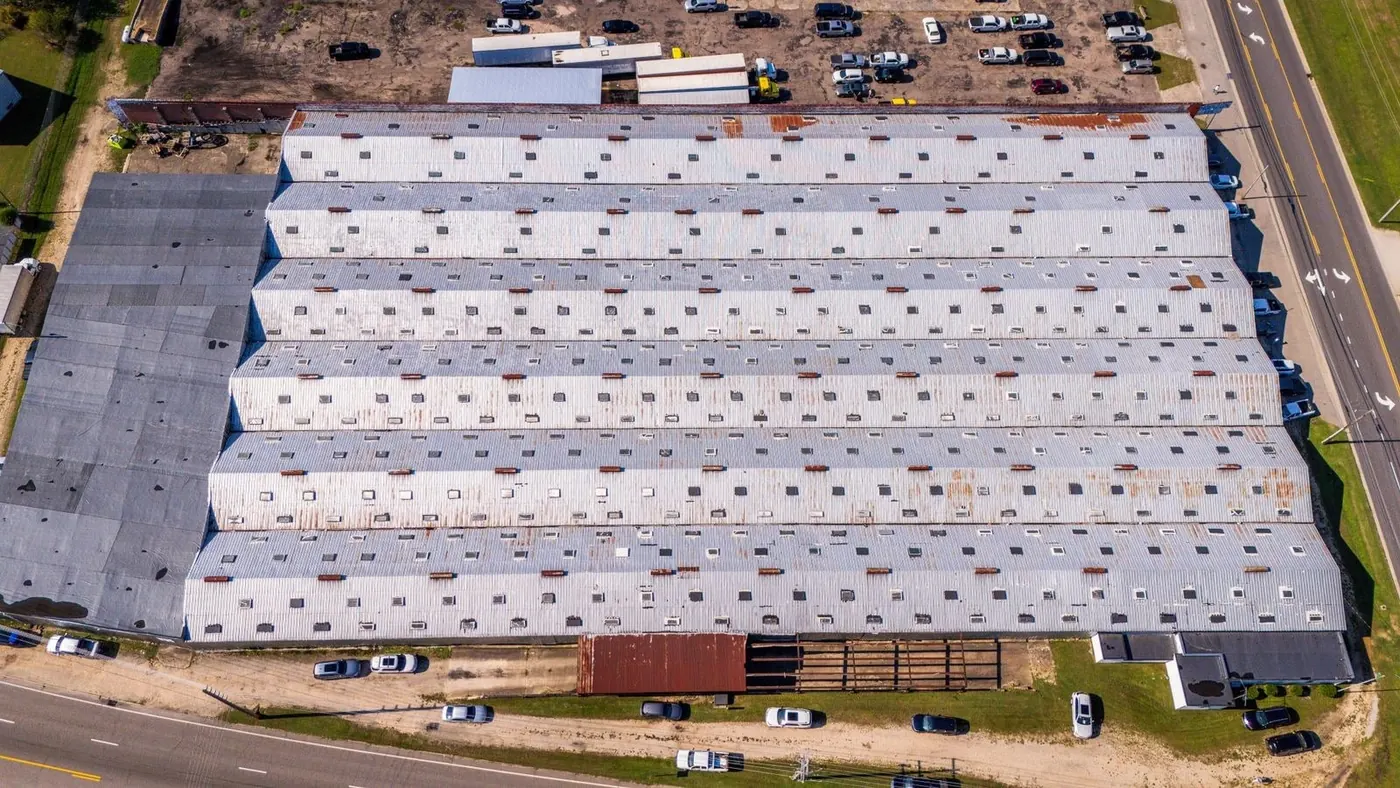
Where do warehouse roofs fail first across a large span?
Warehouse roofs usually fail first in 5 zones: skylight curbs, the strip above the dock wall, around rooftop units, at interior drains, and along the perimeter where wind uplift peaks.
| Roof zone | Typical defect | What it does inside | Scan priority |
|---|---|---|---|
| Skylight curbs | Cracked lenses, open curb flashing | Drips onto aisles and pallets | High |
| Above dock doors | Ponding near parapets, damaged edge metal | Water at loading doors and dock levelers | High |
| Rooftop units | Disturbed curb flashing after service calls | Leaks over offices and break rooms | Medium |
| Interior drains | Clogged strainers, loose clamping rings | Large wet areas that spread unseen | High |
| Perimeter and corners | Fastener back-out, edge lift | Membrane billowing, then tearing | Medium |
Why are skylights the biggest leak risk on a warehouse?
A large warehouse can carry 100 or more skylights, and each 1 adds 4 curb sides of flashing plus a plastic lens that yellows, cracks and eventually lets water straight through.
Skylights are also a fall hazard. Crews walking a roof with dozens of unguarded openings need screens or guardrails, and that safety equipment has to be in place before any inspector or roofer works near them. Our scan reads the roof without anyone pacing between skylights, and the Deficiency Map locates every cracked lens and open curb by position on the roof plan.
Many owners use a reroof or major repair to reduce skylight count or replace older domes with insulated units. The scan shows which curbs already have wet insulation around them, which is often a better guide to replacement order than lens appearance.
How does racked inventory change the cost of a roof leak?
A single leak above racking can wet product on 5 or 6 pallet levels before anyone notices, so the cost of 1 drip is measured in damaged inventory, not in roofing.
- High-bay racking hides the ceiling, so stains and drips are seen late.
- Water follows purlins and joists, landing well away from the entry point.
- Wet cartons collapse, which can bring down product from upper levels.
- Tenants with contracts that hold the landlord responsible for roof damage pass claims straight back.
- Automated conveyors and sortation equipment stop if water reaches electrical components.
How does contractor traffic damage a warehouse roof?
HVAC, solar, sprinkler and telecom contractors can cross a warehouse roof dozens of times a year, and each trip without walkway pads risks 1 more puncture or scuffed seam.
Mark the paths
Walkway pads from the roof hatch to each unit keep boots off the field membrane.
Log every visit
A simple sign-in record shows who was on the roof before a new leak appeared.
Check after service
Curbs and panels opened by mechanical crews are re-sealed and inspected.
Compare each scan
Year-over-year Deficiency Maps show where traffic is wearing the surface.
What does a warehouse roof program cost per square foot?
Our programs run $0.12 to $0.45 per square foot per year depending on tier, so a 400,000 square foot distribution roof falls between about $48,000 and $180,000 a year.
400,000 sq ft multiplied by each tier's per-square-foot rate. Minimums apply to smaller roofs.
Tiers, minimums and what each includes are on maintenance programs and pricing. Owners comparing the cost of the scan alone can see inspection cost.
Other industries we serve
FAQs
How long does a warehouse roof inspection take?
Our scan covers about 50,000 square feet an hour, so a 400,000 square foot roof takes about 8 hours.
Can you scan while the warehouse is operating?
Yes. The scan needs no interior access and does not affect dock or racking operations.
Do skylights need special attention?
Yes. Each skylight curb is checked for open flashing and wet insulation, and fall protection is used near them.
Who pays for warehouse roof repairs?
It depends on the lease. Many industrial leases assign the roof structure to the landlord and routine upkeep to the tenant.
How often should a distribution center roof be inspected?
Twice a year, plus after major storms or heavy contractor work.
Can a warehouse roof be restored instead of replaced?
Often, if the Moisture Map shows the insulation is mostly dry.
What roof types are common on warehouses?
Mechanically attached TPO, built-up, modified bitumen and spray foam.
Do you install walkway pads?
Yes, as part of repairs or a maintenance program.
Can you work on roofs with solar panels?
Yes, around existing arrays, coordinating with the solar owner where panels need to move.
Does the report help with tenant disputes?
Yes. A dated, PE-stamped record shows roof condition before and after a tenancy.
How do I schedule a warehouse roof inspection?
Request a roof scan or call (310) 647-7192.
Find every wet area across your warehouse roof in 1 visit.
Trusted since 1983 on over 20,000 commercial roofs. California License 435836.